Quick answer: The most common appliance error codes across all household appliances fall into five universal categories — temperature errors, water supply or drainage errors, door or lid errors, motor or mechanical errors, and control board errors. A power reset (unplug for 5 minutes) is always the first step. Error codes are not standardized across brands — always look up the code with your specific brand and model number.
The Week Every Appliance in My House Broke at Once
It started with the refrigerator displaying “Er-dH” on a Monday. By Wednesday, the dishwasher was flashing “E4.” On Friday, the dryer stopped mid-cycle with “AF” on the display. Three appliances, three error codes, three separate diagnoses — all in one week. I had never looked up an appliance error code before that Monday. By Friday, I had become reluctantly proficient at it.
What I discovered across those three repairs was that appliance error codes, despite varying by brand and model, follow consistent patterns. The same diagnostic logic applies whether you are looking at a refrigerator, a dishwasher, or a dryer. This guide to the most common appliance error codes is the overview I wish I had found at the start of that week — a single reference that explains the universal patterns before you dive into the model-specific details.
Why Appliance Error Codes Are Not Standardized — and What That Means for You
The most important thing to understand about appliance error codes is that they are not standardized across brands or even across product lines within the same brand. An “E1” on a Samsung washing machine means something entirely different from an “E1” on a Whirlpool dishwasher or a Bosch oven. A code that indicates a temperature sensor error on one brand may indicate a drainage error on another.
This lack of standardization means that generic error code searches — “E1 error code appliance” — are often misleading. The correct search is always: your brand name + your model number + the error code. The model number is typically found on a label inside the door, on the back of the appliance, or in the owner’s manual. With the correct model number, you can find the exact service documentation for your appliance and get an accurate diagnosis.
Despite this lack of standardization, the underlying fault categories are consistent across all appliance types. Understanding these categories — and the diagnostic logic that applies to each — allows you to approach any error code systematically, regardless of the brand or model.
The 5 Universal Appliance Error Code Categories
1. Temperature Errors — Sensor or Heating Element Failure
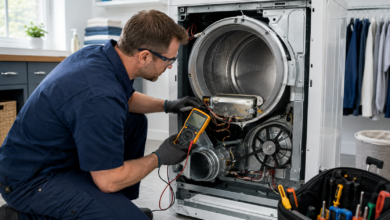
Temperature errors appear across refrigerators, ovens, dryers, dishwashers, and coffee machines. They indicate that a component is not reaching or maintaining the required temperature. The two most common causes are a failed temperature sensor (thermistor or RTD) and a failed heating element. Temperature sensors can be tested with a multimeter — the expected resistance at a given temperature is listed in the service manual. Heating elements can be tested for continuity.
Temperature sensors are generally inexpensive ($10–$40) and accessible. Heating elements vary by appliance — a dryer heating element costs $20–$50, an oven bake element costs $20–$50, and a dishwasher heating element costs $20–$50. In all cases, the diagnostic process is the same: test the sensor first, then the element, then consider the control board if both components test correctly.
2. Water Supply and Drainage Errors — Valve, Pump, or Filter Issues
Water-related errors appear across washing machines, dishwashers, refrigerators (ice makers), and coffee machines. They indicate that water is not entering the appliance at the expected rate (supply error) or not leaving the appliance at the expected rate (drainage error). The most common causes are a clogged filter, a kinked or blocked hose, a failed water inlet valve solenoid, or a failed drain pump.
The diagnostic sequence for water errors is consistent: check the filter first (clean or replace), then check the hose for kinks or blockages, then check the valve or pump. Water filters are the most frequently overlooked maintenance item across all water-using appliances — a clogged filter is responsible for a disproportionate share of water supply errors.
3. Door and Lid Errors — Latch or Switch Failure
Door and lid errors appear across washing machines, dishwashers, ovens (self-clean door lock), and microwaves. They indicate that the control board is not receiving confirmation that the door or lid is properly closed and latched. The appliance will not start or will stop mid-cycle if the door-lock signal is lost.
⚠️ Important note: For oven door-lock errors after a self-clean cycle, never attempt to force the door open. Allow the oven to cool completely (1–2 hours), then try a circuit breaker reset. Forcing the door can damage the latch mechanism and the door itself. For all other door errors, check first that nothing is obstructing the door from closing fully before assuming a latch or switch failure.
4. Motor and Mechanical Errors — Drive Motor, Belt, or Pump Failure
Motor and mechanical errors appear across washing machines, dryers, dishwashers, and vacuum cleaners. They indicate that a motor-driven component — the drum drive motor, the drain pump motor, the wash pump motor, or the brush roll motor — is not operating correctly. A broken drive belt (dryers, some washing machines) is a common mechanical failure that is generally accessible for DIY repair.
Motor failures are more expensive than sensor or element failures — a drive motor typically costs $50–$150 for the part. Before replacing a motor, confirm that the motor is actually the failed component: check for a broken belt, a jammed impeller, or a seized bearing first. A motor that appears to have failed may simply be overloaded by a mechanical obstruction.
5. Control Board and Communication Errors — Board Failure or Power Surge
Control board errors appear across all appliance types. They indicate a failure in the main electronic control board or a communication error between the control board and a component. A power reset clears many temporary control board errors caused by power fluctuations. Persistent control board errors may indicate a failed relay, a failed triac, or general board failure due to power surge or heat damage.
Control board replacement is one of the more expensive appliance repairs — boards typically cost $80–$300 depending on the appliance and brand. Before replacing a control board, confirm that the error is not caused by a failed component that is sending incorrect signals to the board. A shorted heating element or a failed motor can damage the control board — replacing the board without addressing the root cause will result in the new board failing as well.
Appliance-by-Appliance Error Code Overview
Step 1: Refrigerator Error Codes
The most common refrigerator error codes involve the defrost system (Er-dH, Er-dF), temperature sensors (Er-S, Er-1), and fan motors (Er-F, Er-FF). Defrost errors are the most frequently encountered — a failed defrost heater or thermostat causes ice to accumulate on the evaporator coils, restricting airflow and leading to poor cooling. Manual defrosting provides temporary relief; the faulty component must be identified and replaced for a permanent fix. For a complete refrigerator error code guide, see the dedicated refrigerator troubleshooting article.
Step 2: Washing Machine Error Codes
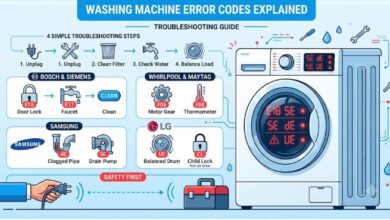
The most common washing machine error codes involve water supply (E3, IE, no fill), drainage (E1, OE, no drain), door or lid lock (dE, LE), and motor or drum errors (E6, UE for unbalanced load). Drainage errors are the most common — a clogged pump filter (located behind a small access panel at the front bottom of most front-load washers) is the most frequent cause and is a straightforward DIY fix. An unbalanced load error (UE) is not a fault — it indicates the drum load needs to be redistributed before the spin cycle can complete.
Step 3: Dishwasher Error Codes
The most common dishwasher error codes involve drainage (E1, OE, F1), water supply (E3, IE), heating (E2, HE), leaks (E4, LE, AE), and door-lock issues (dE, F8). Drainage errors are the most common — cleaning the filter at the bottom of the dishwasher tub resolves the majority of drainage errors. Leak errors (E4, LE) require identifying the source of the leak before the error will clear — the base pan must be dried out to reset the anti-flood float switch.
Step 4: Dryer Error Codes
The most common dryer error codes involve airflow restriction (AF, d80, d90), heating (E1, HE — thermal fuse or element), moisture sensors (E3, F3), and motor or belt issues (E5, F5). Airflow errors are the most safety-critical — a blocked dryer vent is a leading cause of residential dryer fires. Stop using the dryer immediately when an airflow error appears and clean the full vent system before restarting. A blown thermal fuse (the most common heating error) is almost always caused by a blocked vent — always clean the vent before replacing the fuse.
Step 5: Oven, Microwave, and Other Appliance Error Codes
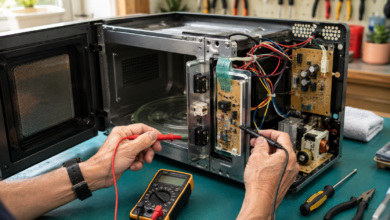
Oven errors most commonly involve temperature sensors (F3, E1 — RTD failure) and door-lock issues after self-clean cycles (F9, E5). The self-clean cycle is the leading cause of oven component failure — running it less frequently extends the life of sensors, control boards, and door-lock motors. Microwave errors require special attention: keypad and sensor errors are DIY-accessible, but any error involving internal components (door switches, magnetron, capacitor) requires professional service due to the lethal high-voltage capacitor inside every microwave. Coffee machine and vacuum cleaner errors are almost always resolved by cleaning — descaling for coffee machines, filter and sensor cleaning for vacuums.
Frequently Asked Questions About Appliance Error Codes
What are the most common appliance error codes?
The most common appliance error codes across all household appliances fall into five categories: temperature errors (sensor or heating element failure), water supply or drainage errors (valve, pump, or filter issues), door or lid errors (latch or switch failure), motor or mechanical errors (drive motor, belt, or pump failure), and control board errors (board failure or power surge damage). A power reset is always the first troubleshooting step.
How do I reset an appliance error code?
Unplug the appliance from the power outlet (or turn off the circuit breaker for hardwired appliances) and wait 5 minutes before restoring power. This performs a hard reset of the control board and clears temporary error codes. If the error returns after the reset, the underlying fault has not been resolved and the relevant component needs to be diagnosed and potentially replaced.
What does an E1 error code mean on a home appliance?
E1 means different things on different appliances and brands — there is no universal standard. On a washing machine, E1 often indicates a water supply error. On a dryer, E1 may indicate a heating error. On a dishwasher, E1 may indicate a drainage error. Always search for the code with your specific brand name and model number for an accurate diagnosis — never rely on generic code lookups.
When should I call a technician for an appliance error code?
Call a technician if: the error reappears after a reset and basic cleaning; the error involves a gas component (gas oven or dryer); the error involves microwave internal components (magnetron, capacitor, door switches); the appliance is under warranty; or DIY part costs approach 50% of the appliance’s replacement value. For microwave high-voltage repairs, professional service is always recommended.
Are appliance error codes standardized across brands?
No — appliance error codes are not standardized. The same code can mean entirely different things on different brands and even on different models within the same brand. Always look up the error code with your specific brand name and model number. The model number is typically found on a label inside the door, on the back of the appliance, or in the owner’s manual.
Appliance Repair Cost Comparison by Appliance Type
The table below provides estimated repair cost ranges for the most common error code causes across major household appliances in the United States. DIY costs reflect the part only; professional costs include a typical service call and labor.
| Appliance | Most Common Error Cause | DIY Part Cost (USD) | Professional Repair Cost (USD) |
|---|---|---|---|
| Refrigerator | Defrost thermostat or heater | $10 – $40 | $150 – $300 |
| Washing Machine | Drain pump filter cleaning or pump replacement | $0 – $50 | $100 – $250 |
| Dishwasher | Filter cleaning or door seal replacement | $0 – $40 | $100 – $250 |
| Dryer | Vent cleaning or thermal fuse replacement | $0 – $20 | $100 – $250 |
| Oven | RTD temperature sensor replacement | $15 – $40 | $100 – $200 |
| Microwave | Keypad replacement (DIY-safe) | $20 – $60 | $80 – $200 |
| Ice Maker | Water filter or ice maker assembly | $20 – $150 | $100 – $300 |
| Coffee Machine | Descaling cycle | $5 – $15 | $60 – $150 |
| Vacuum Cleaner | Filter cleaning or battery replacement | $0 – $80 | $50 – $150 |
Note: Costs are estimates based on typical U.S. market rates as of 2024–2025. As a general rule, if professional repair costs exceed 50% of the appliance’s current market value, replacement may be more cost-effective. Always obtain a written estimate before authorizing repairs. Gas appliance repairs involving gas components and microwave high-voltage repairs require a qualified technician.
Conclusion: One Diagnostic Logic for Every Appliance
The week that three of my appliances broke simultaneously was frustrating — but it taught me that appliance error codes, despite their apparent complexity, follow a consistent logic. Every error code points to one of five fault categories. Every diagnosis starts with a power reset and the simplest possible checks. Every repair decision involves the same cost-benefit framework: part cost versus service call cost versus replacement cost.
The most common appliance error codes are not mysterious. They are the appliance’s way of telling you exactly what is wrong — if you know how to read them. The key is always to look up the code with your specific brand and model number, identify the fault category, and work through the diagnostic steps in order of simplicity and accessibility. In most cases, the fix is a $10–$40 part and 20 minutes of work.
The exceptions — microwave high-voltage components, gas appliance gas components, and sealed refrigeration systems — are clearly defined and consistently require professional service. For everything else, a multimeter, your model’s service documentation, and a methodical approach will resolve the majority of household appliance error codes.
Sources
- U.S. Consumer Product Safety Commission (CPSC) — Home Appliance Safety Guidelines. Available at: www.cpsc.gov
- Association of Home Appliance Manufacturers (AHAM) — Industry Standards and Consumer Resources for Major Home Appliances. Available at: www.aham.org
- U.S. Fire Administration (FEMA) — Home Appliance Fire Safety Statistics. Available at: www.usfa.fema.gov
- International Society of Certified Electronics Technicians (ISCET) — Appliance Service Technician Certification Standards. Available at: www.iscet.org
- Consumer Reports — Major Appliance Reliability and Repair Cost Survey, 2023. Available at: www.consumerreports.org