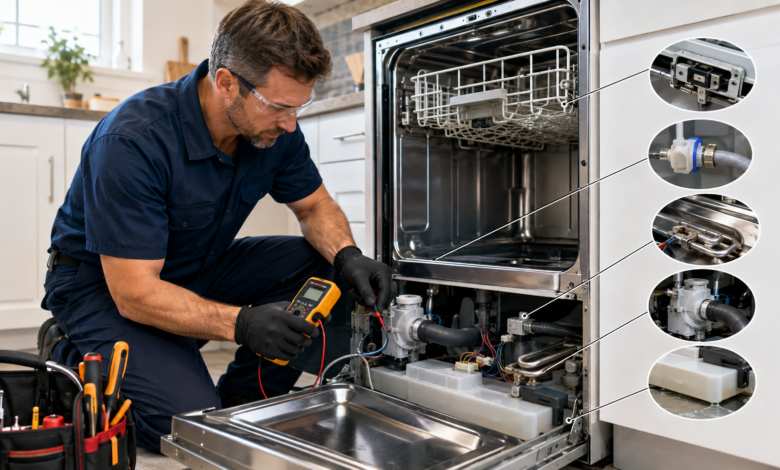
Quick answer: A dishwasher error codes guide covers five main fault categories — drainage errors (clogged filter or failed drain pump), water supply errors (inlet valve or water pressure issues), heating errors (failed element or thermistor), leak errors (anti-flood float switch triggered), and door-lock errors (latch or switch failure). Most drainage and heating errors are DIY-accessible; leak and control board errors may require professional assessment.
“E4” — The Code That Stopped My Dishwasher Mid-Cycle
It happened on a Sunday afternoon, right in the middle of a wash cycle. The dishwasher beeped three times, the display flashed “E4,” and the machine stopped completely. Water was sitting at the bottom of the tub. I opened the door, found nothing obviously wrong, and closed it again — the cycle refused to restart. The dishwasher just kept flashing E4 and running the drain pump in a loop.
I had never looked up a dishwasher error code before. What followed was two hours of research, a flashlight under the machine, and a surprisingly simple fix. This dishwasher error codes guide is what I wish I had found that Sunday — a clear, practical breakdown of what the most common codes mean and what to do about them.
How Dishwasher Error Codes Work
Modern dishwashers use electronic control boards that monitor every stage of the wash cycle — water fill, temperature, spray arm pressure, drain time, and door status. When a sensor reading falls outside the expected range, or a component fails to respond within a set time, the control board logs a fault and displays an error code on the panel.
Like refrigerator error codes, dishwasher codes are not standardized across brands. An “E1” on a Bosch means something different from an “E1” on a Whirlpool or an LG. However, the underlying fault categories are consistent: drainage, water supply, heating, leaks, and door-lock issues account for the vast majority of dishwasher error codes encountered in practice.
Some appliance technician surveys suggest that drainage errors and heating element failures are among the most frequently reported dishwasher faults. Both are generally accessible for DIY repair, which makes understanding these codes particularly valuable before calling a service technician.
Dishwasher Error Codes: 5 Categories Explained
1. Drainage Error Codes — Water Not Draining
Drainage error codes (commonly E1, F1, OE, or a drain icon depending on brand) indicate that the dishwasher failed to drain within the expected time window — typically 2–3 minutes. The most common cause is a clogged filter. The filter assembly at the bottom of the dishwasher tub collects food debris and should be cleaned every 1–4 weeks depending on usage. A blocked filter restricts water flow to the drain pump and can trigger a drainage error even when the pump itself is functioning correctly.
If cleaning the filter does not resolve the error, check the drain hose for kinks or blockages, and verify that the drain hose connection at the sink or garbage disposal is clear. If the hose is clear and the filter is clean, the drain pump motor may have failed — a component that can be tested with a multimeter and replaced for $20–$60 in most models.
2. Water Supply Error Codes — Not Filling Correctly
Water supply error codes (often E3, F3, IE, or a water tap icon) indicate that the dishwasher is not receiving water, or is not filling to the required level within the expected time. Common causes include a closed or partially closed water supply valve under the sink, low household water pressure, a kinked inlet hose, or a failed water inlet valve solenoid.
Start by confirming the water supply valve is fully open and the inlet hose is not kinked. If water pressure is adequate and the hose is clear, the water inlet valve may be partially blocked by mineral deposits — a common issue in hard water areas. The inlet valve screen can sometimes be cleaned; if the solenoid has failed, the valve assembly typically needs replacement ($15–$40).
3. Heating Error Codes — Water Not Reaching Temperature
Heating error codes (commonly E2, F2, HE, or a temperature icon) indicate that the wash water is not reaching the required temperature — typically 50–65°C (122–149°F) — within the wash cycle time limit. The most common cause is a failed heating element. The heating element is a resistive coil at the bottom of the dishwasher tub that heats the water during the wash and drying phases.
A heating element can be tested with a multimeter: disconnect power, access the element terminals (usually from underneath the machine), and test for continuity. A reading of infinite resistance (open circuit) confirms the element has failed. Replacement elements are widely available for $20–$50 and the replacement process is accessible for a confident DIYer. A faulty thermistor (temperature sensor) can produce the same error code and should be tested if the element tests good.
4. Leak Error Codes — Anti-Flood Float Switch Triggered
Leak error codes (often E4, LE, AE, or a flood icon) are triggered by the anti-flood float switch located in the base pan of the dishwasher. When water accumulates in the base — due to a leak from any internal component — the float rises and activates the switch, which signals the control board to run the drain pump continuously and prevent a new cycle from starting.
⚠️ Important note: A leak error code does not tell you where the leak originated — it only tells you that water reached the base pan. Common sources include a deteriorated door seal, a cracked or loose spray arm, a loose hose connection inside the machine, or a faulty water inlet valve that allows overfilling. The base pan must be completely dried out (tilt the machine forward carefully to drain, or use a towel) before the float switch resets and the error clears.
5. Door-Lock Error Codes — Latch or Switch Failure
Door-lock error codes (often dE, F8, a door icon, or a blinking start light) indicate that the control board is not receiving confirmation that the door is properly latched. The dishwasher will not start or will stop mid-cycle if the door-lock signal is lost. Common causes include a misaligned door latch, a worn door strike plate, or a failed door latch switch (microswitch).
Check first that nothing is obstructing the door — a dish rack positioned too far forward is a surprisingly common cause. If the door closes and latches physically but the error persists, the door latch switch may have failed. The switch can be tested with a multimeter for continuity when the latch is engaged. Replacement latch assemblies are typically $15–$35 and are one of the more straightforward dishwasher repairs.
How I Found and Fixed My E4 Leak Error — Step by Step
Step 1: Identify the Error Code and Its Category
My first step was to look up “E4 dishwasher error” along with my machine’s brand and model number. The service documentation confirmed that E4 on my model indicated the anti-flood float switch had been triggered — meaning water had reached the base pan. This was more serious than a clogged filter, but it also meant the machine was working as designed: it had detected a problem and stopped to prevent a flood.
What surprised me: the error code was not the problem — it was the symptom. The real question was where the water in the base pan had come from.
Step 2: Dry Out the Base Pan
I carefully tilted the dishwasher forward (with a helper) to drain the water from the base pan into towels on the floor. Once the pan was dry, I plugged the machine back in — the E4 error had cleared and the drain pump stopped running continuously. This confirmed the float switch itself was working correctly.
Step 3: Identify the Source of the Leak
I ran a short wash cycle while watching the machine from the front with the kick plate removed. Within two minutes, I could see water dripping from the door seal at the bottom left corner. The door seal had developed a small crack — invisible from the inside of the tub but clearly the source of the leak.
Step 4: Replace the Door Seal
A replacement door seal for my model cost $22 online. The installation took about 30 minutes — the old seal pulled out of its channel, and the new one pressed in. No tools required beyond a flathead screwdriver to start the seal in the channel. I ran three full cycles after the repair with no recurrence of the E4 error.
Step 5: Prevent Future Errors with Regular Maintenance
After the repair, I established a monthly maintenance routine: clean the filter, inspect the door seal for cracks or debris, run a dishwasher cleaner tablet through an empty hot cycle, and check the spray arms for blocked nozzles. Some appliance maintenance guides suggest that regular filter cleaning alone can prevent the majority of drainage errors. The E4 experience was frustrating, but it taught me that most dishwasher errors are preventable with basic maintenance.
Frequently Asked Questions About Dishwasher Error Codes
What do dishwasher error codes mean?
Dishwasher error codes are fault codes displayed on the control panel to indicate a specific malfunction detected by the control board. They fall into five main categories: drainage errors, water supply errors, heating errors, leak errors, and door-lock errors. The exact code varies by brand and model — always look up your specific model number alongside the code for accurate diagnosis.
How do I fix a dishwasher drainage error code?
Start by cleaning the filter assembly at the bottom of the dishwasher tub — this resolves the majority of drainage errors. If the filter is clean, check the drain hose for kinks or blockages, and verify the drain connection at the sink or garbage disposal is clear. If these checks pass, the drain pump motor may have failed and will need to be tested with a multimeter and potentially replaced.
What causes a dishwasher heating error code?
A heating error code most commonly indicates a failed heating element — the resistive coil at the bottom of the tub that heats wash water and aids drying. The element can be tested with a multimeter for continuity; an open circuit confirms failure. A faulty thermistor (temperature sensor) can produce the same error and should be tested if the element is intact. Both components are generally accessible and affordable to replace.
What does a dishwasher leak error code mean?
A leak error code means the anti-flood float switch in the base pan has detected water accumulation. The dishwasher will run the drain pump continuously and refuse to start a new cycle until the base pan is dried out and the float switch resets. The source of the leak must be identified and repaired — common sources include the door seal, spray arms, internal hose connections, and the water inlet valve.
How do I fix a dishwasher door-lock error code?
First, check that no dish rack or utensil is preventing the door from closing fully. If the door closes and latches physically but the error persists, the door latch switch (microswitch) may have failed. Test the switch with a multimeter for continuity when the latch is engaged — no continuity confirms failure. Replacement latch assemblies are typically $15–$35 and are one of the more straightforward dishwasher repairs.
Dishwasher Repair Cost Comparison by Error Type
The table below provides estimated repair costs for common dishwasher error code causes in the United States. DIY costs reflect the part only; professional costs include a typical service call and labor. Costs are indicative and vary by brand, region, and model.
| Error Type | Common Cause | DIY Part Cost (USD) | Professional Repair Cost (USD) |
|---|---|---|---|
| Drainage Error (E1 / OE / F1) | Clogged filter or failed drain pump | $0 – $60 | $100 – $250 |
| Water Supply Error (E3 / IE / F3) | Water inlet valve replacement | $15 – $40 | $100 – $200 |
| Heating Error (E2 / HE / F2) | Heating element or thermistor | $20 – $50 | $150 – $300 |
| Leak Error (E4 / LE / AE) | Door seal, hose, or inlet valve | $10 – $40 | $100 – $250 |
| Door-Lock Error (dE / F8) | Door latch or latch switch | $15 – $35 | $100 – $200 |
| Control Board Error | Main control board replacement | $80 – $200 | $200 – $450 |
Note: Costs are estimates based on typical U.S. market rates as of 2024–2025. Always obtain a written estimate before authorizing repairs. If repair costs exceed 50% of the dishwasher’s current market value, replacement may be more cost-effective.
Conclusion: Most Dishwasher Errors Are Fixable — If You Know Where to Look
The E4 error that stopped my dishwasher mid-cycle turned out to be a $22 door seal and 30 minutes of work. Without knowing what the code meant, I might have called a technician and paid $150–$250 for the same repair. That is the core value of a dishwasher error codes guide: it converts a confusing alphanumeric code into a specific, actionable diagnosis.
The five error categories covered in this guide — drainage, water supply, heating, leaks, and door-lock — account for the vast majority of dishwasher faults. Most involve components that are accessible, inexpensive, and replaceable without specialized tools. The exceptions are control board failures and sealed system issues, which are less common but more complex and expensive to address.
When your dishwasher displays an error code, resist the urge to call a technician immediately. Look up the code for your specific brand and model, identify the fault category, and work through the diagnostic steps in order — starting with the simplest and most accessible checks. In many cases, the fix is closer — and cheaper — than you expect.
Sources
- U.S. Department of Energy — Energy Saver: Dishwasher Tips and Maintenance. Available at: energy.gov/energysaver/dishwashers
- Association of Home Appliance Manufacturers (AHAM) — Dishwasher Industry Standards and Consumer Resources. Available at: www.aham.org
- International Society of Certified Electronics Technicians (ISCET) — Appliance Service Technician Certification Standards. Available at: www.iscet.org
- Pakula C, Stamminger R — «Electricity and water consumption for laundry and dishwashing by washing machine and dishwasher in 23 European countries». Energy Efficiency, 2010.
- Consumer Reports — Dishwasher Reliability and Repair Cost Survey, 2023. Available at: www.consumerreports.org