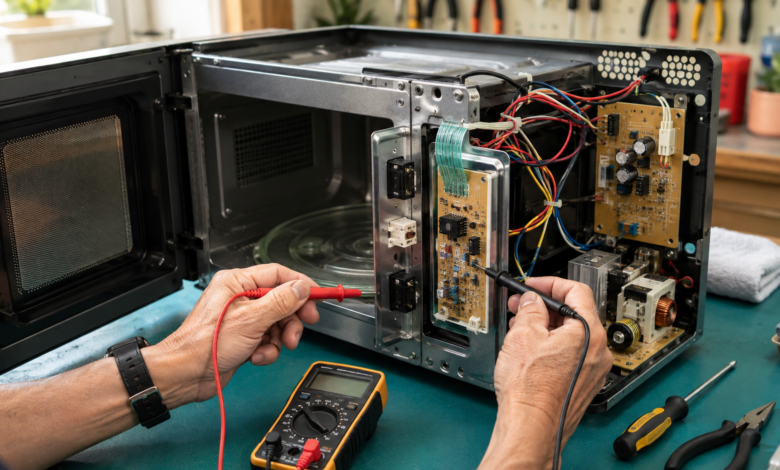
Quick answer: Microwave error codes explained cover four main fault categories — door switch errors (interlock switch failure), keypad errors (stuck or shorted key), sensor errors (humidity or temperature sensor malfunction), and power supply errors (magnetron, capacitor, or diode failure). Keypad and door switch errors are the most common; power supply errors require professional service due to the lethal high-voltage capacitor inside every microwave.
“SE” — The Code That Appeared on My Microwave at 7 AM
I pressed the “Start” button on my microwave one morning and nothing happened. The display showed “SE” and the keypad was completely unresponsive. I unplugged it, waited a minute, plugged it back in — “SE” returned immediately. I had never seen this code before and assumed the microwave was dead.
It turned out to be a stuck key on the membrane keypad — caused by a small amount of moisture that had gotten under the keypad surface. A replacement keypad cost $35 and took 20 minutes to install. This microwave error codes explained guide covers the most common fault categories, what they mean, and — critically — which repairs are safe to attempt yourself and which require a professional.
How Microwave Error Codes Work — and Why Safety Matters
Modern microwaves use electronic control boards that monitor door switch status, keypad inputs, magnetron operation, and sensor readings. When a component fails or a sensor reading falls outside the expected range, the control board displays an error code. A power reset (unplugging for 60 seconds) clears many temporary errors; persistent codes indicate a component that needs diagnosis or replacement.
Microwave repair is fundamentally different from other appliance repairs in one critical respect: the high-voltage capacitor. Every microwave contains a capacitor that stores electrical charge at 2,000 volts or more — enough to cause a fatal electric shock. This capacitor retains its charge even after the microwave is unplugged, sometimes for hours or days. Any repair that requires opening the outer cabinet and accessing internal components must begin with properly discharging this capacitor using an insulated discharge tool.
For this reason, microwave error codes fall into two practical categories: those that can be addressed without opening the cabinet (keypad replacement, control board replacement on some models, exterior cleaning for sensor errors), and those that require internal access and should be handled by a qualified technician (door switch replacement, magnetron, capacitor, diode, and transformer issues).
Microwave Error Codes: 5 Categories Explained
1. Door Switch Error Codes — Interlock Switch Failure
Door switch error codes (often F1, E1, or a door icon) indicate that one or more of the door interlock switches has failed. Most microwaves have two or three interlock switches — a primary switch, a secondary switch, and a monitor switch — that must all signal “door closed” before the magnetron can operate. If any switch fails, the microwave will not start or will stop mid-cycle.
Door switch failure is one of the most common microwave faults. The switches are mechanical components that wear with repeated use — each time the door is opened and closed, the switches actuate. Replacement switches are inexpensive ($5–$15 each), but accessing them requires removing the outer cabinet — which means the high-voltage capacitor must be discharged first. This repair is technically accessible for an experienced DIYer who understands the capacitor discharge procedure, but it is not recommended for those unfamiliar with high-voltage safety.
2. Keypad Error Codes — Stuck or Shorted Key
Keypad error codes (commonly SE, 5E, or a key icon on Samsung; similar codes on other brands) indicate that a key on the membrane keypad is sending a continuous signal to the control board — as if it is being held down. Common causes include moisture or food debris under the keypad membrane, physical damage to the keypad, or a manufacturing defect in the membrane itself.
A power reset (unplug for 60 seconds) sometimes clears a temporary keypad error caused by a brief moisture event. If the error persists, the keypad membrane typically needs replacement. On most over-the-range and countertop microwaves, the keypad is accessible from the front panel without opening the high-voltage section of the cabinet — making this one of the safer DIY microwave repairs. Replacement keypads cost $20–$60 depending on the model.
3. Sensor Error Codes — Humidity or Temperature Sensor Malfunction
Sensor error codes (often SE on some models, or a sensor-specific code) indicate a problem with the humidity sensor used in sensor cooking modes. This sensor detects steam released by food during cooking and signals the control board to adjust or end the cooking cycle. A dirty sensor cavity — food splatter on or near the sensor — is a common cause of false sensor errors.
The first step for a sensor error is thorough cleaning of the microwave interior, paying particular attention to the area around the sensor (usually a small vent or probe on the interior ceiling or side wall). If cleaning does not resolve the error, the sensor itself may need replacement. Sensor replacement accessibility varies by model — some sensors are accessible from the interior without opening the cabinet, while others require cabinet disassembly.
4. Power Supply Error Codes — Magnetron, Capacitor, or Diode Failure
Power supply error codes (often F3, E3, or similar) indicate a problem with the high-voltage power supply circuit — the magnetron (the component that generates microwaves), the high-voltage capacitor, the high-voltage diode, or the high-voltage transformer. These components operate at 2,000–4,000 volts during microwave operation and retain dangerous charge levels even after unplugging.
⚠️ Critical safety warning: Do not attempt to diagnose or repair magnetron, capacitor, diode, or transformer failures yourself unless you are a qualified technician with specific training in high-voltage appliance repair. The high-voltage capacitor inside a microwave can deliver a fatal electric shock even when the microwave is unplugged. These repairs must be performed by a qualified technician. Given the cost of professional repair for these components ($150–$400), replacement of the microwave is often more cost-effective for units over 5–7 years old.
5. Control Board Error Codes — Communication or Board Failure
Control board error codes (often F7, E7, or communication-related codes) indicate a failure in the main control board or a communication error between the control board and a component. A power reset clears many temporary control board errors caused by power fluctuations. Persistent control board errors may indicate a failed relay, a failed triac (which controls power to the magnetron), or general board failure.
Control board replacement is accessible on many microwave models without entering the high-voltage section — the board is often located behind the control panel, accessible from the front. Replacement boards cost $50–$150. However, if the control board failure is related to a high-voltage component failure (e.g., a shorted magnetron that damaged the board), replacing the board alone will not resolve the issue.
How I Diagnosed and Fixed My “SE” Keypad Error — Step by Step
Step 1: Identify the Code and Perform a Power Reset
After looking up “SE microwave error” for my specific brand, I confirmed it indicated a stuck key on the keypad. My first step was a power reset: I unplugged the microwave for 60 seconds, then plugged it back in. The SE error returned immediately — confirming the keypad membrane had a persistent fault, not a temporary glitch.
What I had not expected: the service documentation noted that SE errors on my model were frequently caused by moisture under the keypad — not physical damage. The microwave was located above the stove, and steam from cooking had apparently worked its way under the keypad membrane over time.
Step 2: Assess Whether the Repair Requires Cabinet Access
Before ordering any parts, I confirmed that the keypad on my model was accessible from the front panel without opening the outer cabinet. This was critical — it meant I could replace the keypad without needing to discharge the high-voltage capacitor. I found a YouTube repair video for my exact model that confirmed the process: remove the front panel screws, disconnect the keypad ribbon cable, connect the new keypad, reassemble.
Step 3: Order the Correct Replacement Keypad
I ordered a replacement keypad membrane for my model number for $35. When it arrived, I confirmed it matched the original — same dimensions, same connector type, same button layout. Using the wrong keypad for a similar-looking model is a common mistake; always order by exact model number, not by appearance.
Step 4: Replace the Keypad
With the microwave unplugged, I removed the four screws securing the front control panel, carefully disconnected the ribbon cable from the old keypad, and connected the new one. The entire process took about 20 minutes. I plugged the microwave back in — no SE error. The keypad was fully responsive and all functions worked normally.
Step 5: Prevent Future Keypad Moisture Issues
After the repair, I started using the microwave’s vent fan more consistently when cooking on the stovetop below, and I avoided placing boiling pots directly under the microwave. I also wiped the keypad surface dry after any steam exposure. The SE error has not returned. For over-the-range microwaves, steam management is the most effective way to prevent keypad failures.
Frequently Asked Questions About Microwave Error Codes
What do microwave error codes mean?
Microwave error codes are fault codes displayed on the control panel to indicate a specific malfunction. They fall into five main categories: door switch errors, keypad errors, sensor errors, power supply errors, and control board errors. Always look up the code with your specific brand and model number — the same code can mean different things on different brands. A power reset (unplug for 60 seconds) is always the first step.
What causes a microwave door switch error code?
A door switch error indicates that one or more of the door interlock switches has failed. These mechanical switches wear with repeated use. Replacement switches are inexpensive ($5–$15), but accessing them requires opening the outer cabinet and discharging the high-voltage capacitor first. This repair is not recommended for those unfamiliar with high-voltage safety procedures — consider professional service for door switch replacement.
What is a microwave keypad error code?
A keypad error code (often SE, 5E, or similar) indicates a stuck or shorted key on the membrane keypad. Common causes include moisture under the keypad membrane or physical damage. A power reset sometimes clears temporary keypad errors. If the error persists, the keypad membrane typically needs replacement ($20–$60). On many models, the keypad is accessible from the front panel without opening the high-voltage section of the cabinet.
What does a microwave sensor error code mean?
A sensor error code indicates a problem with the humidity sensor used in sensor cooking modes. The most common cause is food splatter on or near the sensor inside the microwave cavity. Thoroughly clean the microwave interior, paying attention to the sensor area (usually a small vent or probe on the interior ceiling or side wall). If cleaning does not resolve the error, the sensor may need replacement.
Is it safe to repair a microwave myself?
Keypad and control board replacements (accessible without opening the high-voltage section) are generally safe for a careful DIYer. Any repair requiring access to internal components — door switches, magnetron, capacitor, diode, transformer — requires discharging the high-voltage capacitor first. The capacitor stores 2,000+ volts even after unplugging and can cause a fatal shock. These repairs should be performed by a qualified technician. Given repair costs, replacement is often more economical for microwaves over 5–7 years old.
Microwave Repair Cost Comparison by Error Type
The table below provides estimated repair costs for common microwave error code causes in the United States. DIY costs reflect the part only; professional costs include a typical service call and labor. Note that for high-voltage components, DIY repair is not recommended regardless of cost.
| Error Type | Common Cause | DIY Part Cost (USD) | Professional Repair Cost (USD) |
|---|---|---|---|
| Keypad Error (SE / 5E) | Membrane keypad replacement | $20 – $60 | $80 – $180 |
| Door Switch Error (F1 / E1) | Interlock switch replacement | $5 – $15 per switch* | $100 – $200 |
| Sensor Error | Cleaning or sensor replacement | $0 – $40 | $80 – $180 |
| Control Board Error (F7 / E7) | Control board replacement | $50 – $150 | $150 – $300 |
| Magnetron Failure | Magnetron replacement | Not recommended DIY | $150 – $350 |
| Capacitor / Diode Failure | High-voltage component replacement | Not recommended DIY | $100 – $250 |
* Door switch parts are inexpensive, but the repair requires high-voltage capacitor discharge and is not recommended as a DIY repair for most users. Note: Costs are estimates based on typical U.S. market rates as of 2024–2025. For microwaves over 5–7 years old, professional repair costs for high-voltage components often approach or exceed the cost of a new unit — replacement may be more cost-effective.
Conclusion: Know Your Limits — Microwave Repair Has a Hard Safety Line
The SE error that made my microwave unresponsive turned out to be a $35 keypad and 20 minutes of work — a repair I could do safely because it did not require opening the high-voltage section of the cabinet. That distinction is the most important concept in this microwave error codes explained guide: the line between repairs that are safe to attempt and repairs that are not.
Keypad errors, sensor cleaning, and control board replacements (on models where the board is accessible from the front) are generally within reach for a careful DIYer. Door switch replacements, magnetron failures, capacitor and diode issues, and transformer problems are not — the high-voltage capacitor inside every microwave stores a potentially fatal charge that persists after unplugging. This is not a risk that can be managed by being careful; it requires specific training and equipment.
For microwaves displaying power supply error codes, the practical question is usually not “can I fix this?” but “is it worth fixing?” A magnetron replacement costs $150–$350 in professional labor and parts. A new countertop microwave of comparable quality costs $100–$200. For units over 5–7 years old, replacement is almost always the more economical choice.
Sources
- U.S. Consumer Product Safety Commission (CPSC) — Microwave Oven Safety Guidelines. Available at: www.cpsc.gov
- Association of Home Appliance Manufacturers (AHAM) — Microwave Oven Industry Standards and Consumer Resources. Available at: www.aham.org
- U.S. Food and Drug Administration (FDA) — Microwave Oven Radiation Safety. Available at: www.fda.gov
- International Society of Certified Electronics Technicians (ISCET) — Appliance Service Technician Certification Standards. Available at: www.iscet.org
- Consumer Reports — Microwave Reliability and Repair Cost Survey, 2023. Available at: www.consumerreports.org