P0300 Code: Random Misfire Explained
Learn what the P0300 random misfire code means, the most common causes, and how to diagnose ignition, fuel, and engine problems before replacing expensive components.

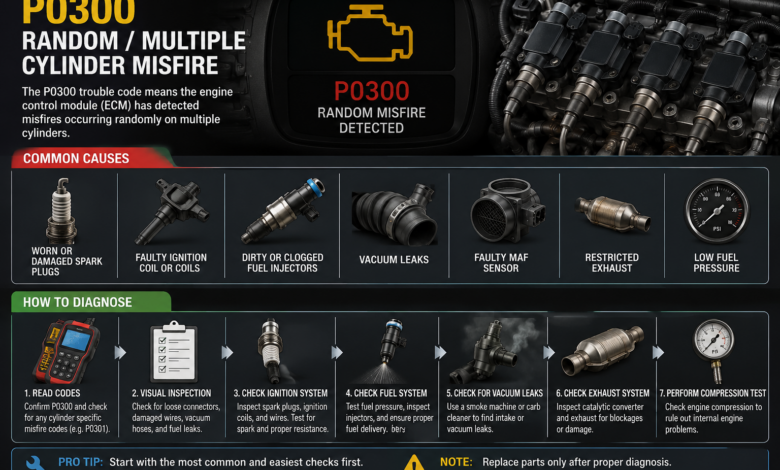
Quick answer: P0300 random misfire means the ECM detected misfires across multiple cylinders. Worn spark plugs are the most common cause — check the maintenance interval first. A flashing check engine light with P0300 means stop driving normally immediately; it signals active catalytic converter damage. Swap ignition coils between cylinders to isolate a faulty coil before buying parts.
“It Felt Like the Engine Was Stumbling Over Itself” — My P0300 Experience
I was sitting at a red light in my 2010 Ford Escape with the 2.5L four-cylinder when I felt it — a rhythmic shudder through the seat, like the engine was stumbling. The idle was rough, the tachometer was bouncing slightly, and then the check engine light came on steady. I pulled into a parking lot and scanned the code: P0300, random multiple cylinder misfire. Alongside it were P0301 and P0303 — cylinders 1 and 3 were the primary offenders. The Escape had 94,000 miles on it and I had no record of the spark plugs ever being replaced.
Replacing all four spark plugs ($32 in parts, 45 minutes of work) resolved the misfire completely. The rough idle disappeared, the P0300 random misfire code cleared, and the engine ran noticeably smoother than it had in months — which told me the plugs had been degrading gradually for long enough that I’d stopped noticing the decline. That experience reinforced the most important rule for P0300 diagnosis: check the maintenance history first. If the spark plugs are overdue, replace them before doing anything else. This article covers the full diagnostic process for P0300 — from the simplest causes to the more serious ones.
How the ECM Detects Misfires — and What P0300 vs. P030X Means
The ECM detects engine misfires by monitoring the crankshaft position sensor signal. Each cylinder’s power stroke produces a brief acceleration in crankshaft rotation; a cylinder that fails to fire produces a brief deceleration instead. The ECM measures these rotational variations and counts misfire events per cylinder per 200 and 1,000 crankshaft revolutions. When misfire counts exceed defined thresholds, the ECM stores a fault code. Cylinder-specific misfires produce codes P0301 through P0308 (one code per cylinder). When misfires are detected across multiple cylinders, or when the misfire pattern shifts between cylinders in a way that cannot be attributed to a single cylinder, P0300 is stored.
P0300 and cylinder-specific codes frequently appear together. P0300 alongside P0301 and P0303 — as in my Escape — means the ECM detected a random misfire pattern with cylinders 1 and 3 as the primary contributors. The cylinder-specific codes are more useful diagnostically than P0300 alone, because they identify where to focus the investigation. When P0300 appears without any cylinder-specific codes, the misfire is genuinely random — shifting between cylinders in a pattern that suggests a cause affecting all cylinders equally, such as low fuel pressure, a failing crankshaft position sensor, or a large vacuum leak.
The severity distinction between a steady and flashing check engine light is most critical with P0300. A steady light indicates misfires below the catalytic converter damage threshold — investigate promptly but not urgently. A flashing light indicates misfires severe enough that the ECM is concerned about catalytic converter damage from unburned fuel entering the exhaust. Reducing speed, avoiding hard acceleration, and addressing the misfire immediately is strongly recommended when the MIL is flashing with P0300.
P0300 Random Misfire: 5 Common Causes and How to Diagnose Each
1. Worn or Fouled Spark Plugs
Worn spark plugs are the most common cause of P0300 on engines with more than 60,000 miles that haven’t had a tune-up. Spark plugs have a defined service life — typically 30,000–60,000 miles for conventional copper plugs and 60,000–100,000 miles for iridium or platinum plugs — after which the electrode gap widens, the electrode material erodes, and the plug requires higher voltage to fire reliably. As plugs wear, they begin to misfire intermittently — particularly under load, at cold temperatures, or at high RPM when the ignition system is under the most stress. Because all plugs wear at roughly the same rate, multiple cylinders often begin misfiring around the same time, producing P0300 rather than a single cylinder-specific code.
Inspecting spark plugs requires removing them — a 30–60 minute job on most four- cylinder engines, longer on V6 and V8 engines with rear bank plugs. A plug in good condition has a light tan or gray electrode with a consistent gap. A worn plug shows a rounded, eroded electrode; a fouled plug shows black carbon deposits (rich mixture or oil fouling) or white/gray deposits (lean mixture or coolant contamination). On my Escape, all four plugs showed significant electrode erosion and a gap approximately twice the specified width — clear evidence of overdue replacement. Spark plug replacement costs $30–$150 in parts for most engines; labor adds $50–$150 on engines with accessible plugs, more on engines with difficult rear bank access.
2. Failing Ignition Coils
Ignition coils convert the vehicle’s 12V battery voltage to the 20,000–40,000 volts required to fire the spark plug. Modern engines use coil-on-plug (COP) designs with one coil per cylinder, or coil packs serving two cylinders each. Coils fail gradually — their internal insulation degrades with heat cycling, eventually causing the coil to arc internally rather than delivering full voltage to the plug. A failing coil often misfires intermittently at first, particularly when cold or under high load, before failing more consistently. Because coils on the same engine age at similar rates, multiple coils can begin failing around the same time, producing P0300.
The most efficient diagnostic technique for ignition coils is the swap test: move the suspected coil to a different cylinder, clear the codes, and drive normally. If the misfire moves to the new cylinder (and a new cylinder-specific code appears), the coil is faulty. If the misfire stays in the original cylinder after the coil swap, the coil is not the cause — the spark plug, fuel injector, or compression in that cylinder is the next thing to investigate. Individual coil replacement costs $30–$80 per coil in parts; replacing all coils simultaneously is often cost-effective on high-mileage engines where multiple coils are near the end of their service life.
3. Vacuum Leak or Low Fuel Pressure
A vacuum leak that admits unmetered air into the intake manifold causes a lean condition across all cylinders — the lean mixture is harder to ignite reliably, particularly at idle and low load, producing misfires across multiple cylinders and P0300. Similarly, low fuel pressure from a failing fuel pump or clogged fuel filter reduces fuel delivery to all injectors simultaneously, causing a lean condition that manifests as random misfires across multiple cylinders. Both causes produce P0300 without consistent cylinder-specific codes — the misfires shift between cylinders because the lean condition affects all cylinders, and which cylinder misfires at any given moment is somewhat random.
Distinguishing between a vacuum leak and low fuel pressure uses fuel trim data: a vacuum leak produces high fuel trim at idle that decreases at higher RPM; low fuel pressure produces high fuel trim across all RPM ranges that worsens under high load. On a 2015 Subaru Outback with P0300 and no cylinder-specific codes, fuel trim was elevated across all RPM ranges and worsened during hard acceleration — a fuel pressure test confirmed the pump was producing 38 PSI against a specification of 49–55 PSI. Fuel pump replacement resolved the P0300 without any ignition system work.
4. Failing Crankshaft Position Sensor
The crankshaft position sensor provides the ECM with the timing reference it uses to fire the ignition coils and fuel injectors at the correct moment. A failing crankshaft position sensor produces an intermittent or erratic signal — causing the ECM to fire the ignition system at incorrect timing, resulting in misfires across all cylinders. A crankshaft position sensor fault often produces P0300 alongside a crankshaft sensor code (P0335 or P0336), which is a useful diagnostic indicator. Symptoms of a failing crankshaft sensor include intermittent stalling, difficulty starting (particularly when hot), and misfires that appear and disappear without a clear pattern.
Crankshaft position sensor replacement is a relatively straightforward repair on most engines — the sensor is typically accessible without major disassembly, secured by one or two bolts. Parts cost $20–$80; labor adds $50–$100. If P0300 appears alongside P0335 or P0336, replacing the crankshaft position sensor before investigating ignition or fuel system components is a reasonable diagnostic step — a faulty sensor can produce misfire symptoms that mimic ignition or fuel system failures.
5. Low Engine Compression
⚠️ Important note: Low engine compression — from worn piston rings, damaged valves, a blown head gasket, or a cracked cylinder head — can cause P0300 that does not respond to spark plug, ignition coil, or fuel system repairs. If P0300 persists after replacing spark plugs and coils, and fuel pressure and vacuum are confirmed normal, a compression test is the next diagnostic step. A compression test requires a compression gauge ($20–$40) and takes 20–30 minutes: remove all spark plugs, disable the ignition and fuel systems, and crank the engine with the gauge installed in each cylinder in turn. Most gasoline engines should produce 150–200 PSI per cylinder, with no more than 10–15% variation between cylinders. A cylinder reading significantly below the others — or below 100 PSI — indicates a compression problem that requires further investigation. Low compression repairs are the most expensive P0300 cause: a valve job runs $500–$1,500; a head gasket replacement costs $1,000–$2,500; piston ring replacement requires engine removal and typically costs $2,000–$4,000 or more. Confirming low compression before authorizing any of these repairs is essential.
Step-by-Step: How I Diagnose P0300 Before Buying Any Parts
Step 1: Check the Maintenance History and Note All Stored Codes
The first thing I do with P0300 is check the vehicle’s maintenance history — specifically when the spark plugs were last replaced. If the plugs are at or past their service interval, replacing them is the correct first step before any further diagnosis. I also read all stored codes: cylinder-specific codes alongside P0300 identify the most affected cylinders and focus the investigation. I check the freeze frame data for the conditions when P0300 was stored — misfires that occur only at cold start suggest different causes than misfires that occur only under hard acceleration.
Step 2: Check for a Flashing Check Engine Light
Before doing anything else, I confirm whether the check engine light is steady or flashing. A flashing light with P0300 means I reduce speed immediately and avoid hard acceleration until the misfire is resolved — the catalytic converter is at risk. A steady light means I have time to diagnose the cause methodically. This distinction determines the urgency of the repair, not the diagnostic approach.
Step 3: Inspect and Replace Spark Plugs If Overdue
If the plugs are overdue or their condition is unknown, I remove and inspect all of them. I look for electrode erosion, fouling, and gap width. If any plug shows significant wear, I replace all plugs simultaneously — replacing only the worst plugs and leaving worn plugs in other cylinders often results in the misfire returning within weeks. I use the plug condition as diagnostic information: oil-fouled plugs suggest oil consumption; carbon-fouled plugs suggest a rich mixture or short-trip driving; white or blistered plugs suggest a lean mixture or overheating.
Step 4: Perform the Ignition Coil Swap Test
If cylinder-specific codes are present alongside P0300, I perform the coil swap test on the affected cylinders. I move the coil from the misfiring cylinder to a known-good cylinder, clear all codes, and drive normally for one to two days. If the misfire moves to the new cylinder (a new cylinder-specific code appears), the coil is faulty and I replace it. If the misfire stays in the original cylinder, I move to spark plug inspection (if not already done) and then fuel injector diagnosis for that specific cylinder.
Step 5: Check Fuel Trim and Fuel Pressure If Misfires Persist
If spark plugs and coils are confirmed good but P0300 persists, I check fuel trim data at idle and at 2,500 RPM. High fuel trim across all RPM ranges points to low fuel pressure or a MAF sensor fault. High fuel trim at idle that decreases at higher RPM points to a vacuum leak. I then perform a fuel pressure test to confirm or rule out a fuel delivery issue. If fuel trim and fuel pressure are normal and the misfire persists, a compression test is the next step — at that point, the cause is likely mechanical rather than ignition or fuel system related.
Frequently Asked Questions — P0300 Random Misfire
What does the P0300 code mean?
P0300 means the ECM has detected misfires occurring across multiple cylinders or in a random pattern that cannot be attributed to a single cylinder. The ECM detects misfires by monitoring crankshaft rotation speed — a misfiring cylinder causes a brief deceleration that the ECM identifies. P0300 often appears alongside cylinder-specific codes (P0301–P0308) that identify the most affected cylinders and provide more specific diagnostic direction.
What are the most common causes of P0300?
Worn or fouled spark plugs are the most common cause, particularly on engines past their tune-up interval. Failing ignition coils are the second most common cause. A vacuum leak or low fuel pressure causing a lean condition across multiple cylinders, a failing crankshaft position sensor, and low engine compression are less common but documented causes. Checking the spark plug maintenance interval is always the correct first step before any other diagnosis.
Is a flashing check engine light with P0300 serious?
Yes — a flashing check engine light with P0300 indicates an active, severe misfire that is sending unburned fuel into the catalytic converter. Sustained driving with a flashing check engine light can destroy the catalytic converter within minutes. Reducing speed, avoiding hard acceleration, and addressing the misfire promptly is strongly recommended. A steady check engine light with P0300 is less urgent but should still be diagnosed and repaired rather than ignored.
How do I find which cylinder is misfiring with P0300?
Check for cylinder-specific codes (P0301–P0308) stored alongside P0300 — these identify the most affected cylinders. Live misfire count data from a scanner shows the misfire rate per cylinder in real time. The coil swap test — moving a coil from a suspected cylinder to a known-good cylinder and observing whether the misfire moves — is the most practical technique for isolating a faulty coil without specialized equipment.
How much does it cost to fix P0300?
Costs range from $30–$150 for spark plug replacement to $2,000–$4,000 or more for piston ring replacement in cases of low compression. Ignition coil replacement runs $50–$150 per coil; replacing all coils on a four-cylinder engine typically costs $150–$400 parts and labor. A fuel injector cleaning service costs $100–$200. Fuel pump replacement runs $300–$700. Accurate diagnosis before authorizing any repair is essential — the same P0300 code can be caused by a $32 set of spark plugs or a $2,500 head gasket repair.
Conclusion & My Take
P0300 is one of the codes where the maintenance history is the most important piece of diagnostic information — more useful, in many cases, than the freeze frame data or the fuel trim values. An engine with 94,000 miles and no record of spark plug replacement has a very high probability of P0300 being caused by worn plugs. Replacing the plugs first, before any other diagnosis, is the correct approach — and it resolves the code in a meaningful proportion of cases without any further investigation.
The coil swap test is the second most useful technique — it requires no special tools, takes 15 minutes, and definitively confirms or rules out a faulty coil before any parts are purchased. Together, spark plug inspection and the coil swap test resolve the majority of P0300 cases. When they don’t, fuel trim data and a fuel pressure test identify whether the cause is in the fuel delivery system. And when all of those are normal, a compression test identifies whether the cause is mechanical — at which point the repair conversation becomes significantly more involved.
Have you dealt with a P0300 code that turned out to be a simple tune-up — or one that revealed a more serious underlying issue? I’d be glad to hear about it in the comments.
Sources
- U.S. Environmental Protection Agency — OBD-II Diagnostic Requirements and Misfire Detection Standards — epa.gov
- NHTSA — Technical Service Bulletin Database (Misfire and Ignition System TSBs) — nhtsa.gov
- SAE International — J1979 OBD-II Misfire Detection and Diagnostic Test Modes — sae.org
- ASE (Automotive Service Excellence) — Engine Performance Certification (Test A8) — ase.com
- CarMD Vehicle Health Index — Annual Report on Most Common Misfire Fault Codes — carmd.com