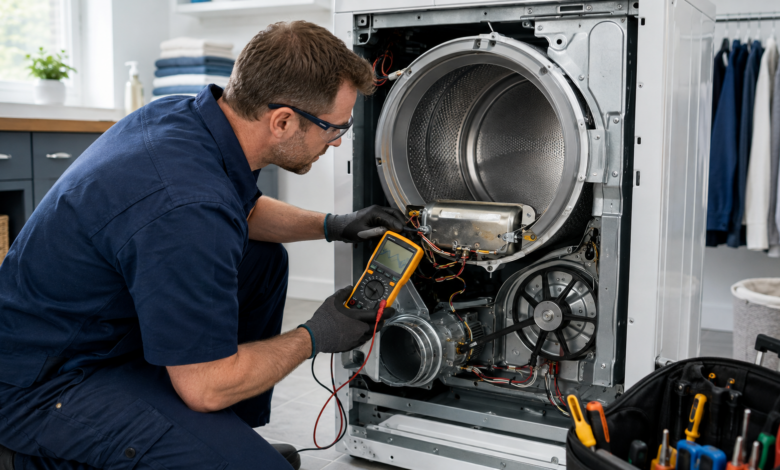
Quick answer: The most important dryer error codes you should know fall into four categories — heating errors (thermal fuse or heating element failure), airflow errors (blocked vent or lint trap), moisture sensor errors (dirty sensor strips), and motor errors (drive motor or belt failure). Airflow errors are the most urgent: a blocked dryer vent is a leading cause of residential fires and should be addressed immediately.
“AF” — The Code That Made Me Check My Dryer Vent for the First Time
I had owned my dryer for four years and never once cleaned the exhaust vent beyond the lint trap. Then one evening, the display flashed “AF” and the dryer stopped mid-cycle with damp clothes inside. I assumed it was a sensor glitch and restarted the cycle. It stopped again after eight minutes. The third time, I finally looked up what “AF” meant.
Airflow restriction. I disconnected the exhaust duct from the back of the dryer and found it packed with lint for the first two feet. The exterior vent cap was nearly completely blocked. I had been running the dryer in a fire-hazard condition for years without knowing it. This dryer error codes you should know guide covers the codes that matter most — and the one that could prevent a house fire.
How Dryer Error Codes Work
Modern dryers use electronic control boards that monitor temperature, airflow, moisture levels, motor operation, and cycle timing. When a sensor reading falls outside the expected range — or a safety threshold is exceeded — the control board logs a fault and displays an error code. Some dryers also store fault codes in memory that can be retrieved through a diagnostic mode even after the code has cleared from the display.
As with other appliances, dryer error codes are not standardized across brands. An “E1” on a Whirlpool means something different from an “E1” on a Samsung or an LG. However, the underlying fault categories are consistent across manufacturers: heating, airflow, moisture sensing, motor operation, and control board communication account for the vast majority of dryer faults.
Fire safety agencies in the United States, including the U.S. Fire Administration, report that failure to clean dryer vents is among the leading causes of residential dryer fires. This makes airflow error codes uniquely important — they are not just a convenience issue but a safety warning.
Dryer Error Codes: 5 Categories You Need to Know
1. Heating Error Codes — No Heat or Insufficient Heat
Heating error codes (commonly E1, F1, HE, or a heat icon) indicate that the dryer is not producing heat or is not reaching the required drum temperature. In electric dryers, the most common causes are a blown thermal fuse or a failed heating element. In gas dryers, the most common causes are a failed igniter, failed gas valve coils, or a blown thermal fuse.
The thermal fuse is a one-time safety device that blows permanently when the dryer overheats — most often due to a blocked exhaust vent. A blown thermal fuse means the dryer will run but produce no heat. It can be tested with a multimeter for continuity (no continuity = blown). Replacement fuses cost $5–$15, but if the underlying cause (vent blockage) is not addressed, the new fuse will blow again. Always clean the vent system before replacing a thermal fuse.
2. Airflow Error Codes — Blocked Vent or Exhaust Restriction
Airflow error codes (often AF, E4, d80, d90, or a vent icon) indicate that the dryer’s sensors are detecting restricted airflow through the exhaust system. Some modern dryers display a percentage-based airflow restriction indicator (e.g., “d80” meaning 80% blockage). This is the most safety-critical dryer error code category.
⚠️ Important note: A blocked dryer vent is a fire hazard. The U.S. Fire Administration reports that dryers cause approximately 2,900 residential fires per year in the United States, with failure to clean the dryer vent being the leading contributing factor. When an airflow error code appears, stop using the dryer until the vent system has been fully cleaned — including the lint trap, the exhaust duct, and the exterior vent cap.
3. Moisture Sensor Error Codes — Dirty or Failed Sensor Strips
Moisture sensor error codes (often E3, F3, or a sensor icon) indicate a problem with the moisture sensor strips — two metal bars inside the dryer drum that detect the electrical conductivity of wet fabric. As clothes dry, conductivity decreases, and the control board ends the cycle. If the sensor strips are coated with dryer sheet residue or fabric softener buildup, they may read incorrectly — causing the dryer to end cycles too early (clothes still damp) or run indefinitely.
Cleaning the sensor strips with rubbing alcohol (isopropyl alcohol) and a soft cloth resolves the majority of moisture sensor errors. The strips are typically located just inside the dryer door opening. If cleaning does not resolve the issue, the sensor assembly may need replacement ($10–$30). A persistent sensor error that does not respond to cleaning may also indicate a control board issue.
4. Motor Error Codes — Drive Motor or Belt Failure
Motor error codes (often E5, F5, or a motor icon) indicate a problem with the drive motor or the drum drive belt. The drive motor rotates the drum and powers the blower wheel. If the motor overheats (often due to a seized bearing or a jammed blower wheel), it may trigger a thermal overload and display a motor error. A broken drive belt will cause the drum to stop rotating while the motor continues to run.
A broken belt is one of the more common dryer repairs and is generally accessible for a DIYer — the dryer cabinet must be disassembled to access the belt, but the replacement process is well-documented for most models. Replacement belts cost $10–$25. A failed drive motor is more expensive ($50–$150 for the part) and may warrant a cost-benefit assessment depending on the age of the dryer.
5. Control Board and Communication Error Codes
Control board error codes (often E6, F6, PF, or communication-related codes) indicate a failure in the main control board or a communication error between the control board and a component. A power failure mid-cycle can sometimes produce a PF (power failure) code that clears after restarting. Persistent control board errors are more complex to diagnose and may require a technician with access to the service manual’s diagnostic mode. Control board replacement costs $80–$200 for the part and may approach or exceed the value of an older dryer.
How I Diagnosed and Fixed My “AF” Airflow Error — Step by Step
Step 1: Identify the Code and Understand the Risk
Looking up “AF dryer error” for my specific brand confirmed it meant airflow restriction. The service documentation noted that the dryer’s sensors had detected that exhaust airflow was below the minimum threshold for safe operation. What I had not expected: the manual explicitly stated that operating the dryer with this error active was a fire risk. I had restarted the cycle twice before reading that.
Lesson learned: airflow error codes are not like other error codes. They are safety warnings, not just performance indicators. Stop the dryer immediately and do not restart it until the vent system is clear.
Step 2: Clean the Lint Trap and Lint Trap Housing
I started with the lint trap — which I cleaned after every cycle — and found it relatively clear. But when I used a long flexible brush to clean the lint trap housing (the slot the trap slides into), I pulled out a significant amount of compacted lint that had accumulated over years. The lint trap catches most debris, but fine lint passes through and accumulates in the housing and duct over time.
Step 3: Disconnect and Clean the Exhaust Duct
I disconnected the flexible exhaust duct from the back of the dryer. The first two feet were packed with lint — enough to significantly restrict airflow. I used a dryer vent cleaning kit (a long flexible brush that attaches to a drill) to clean the entire length of the duct from the dryer to the exterior wall. The kit cost $20 and took about 45 minutes.
Step 4: Clear the Exterior Vent Cap
The exterior vent cap — where the exhaust exits the house — was nearly completely blocked with compacted lint and debris. The flap that should open when the dryer runs was stuck shut. I cleaned it thoroughly and confirmed the flap opened and closed freely. This was the primary restriction point.
Step 5: Reconnect, Test, and Establish a Maintenance Schedule
After reconnecting the duct and running a test cycle, the AF error did not return. Drying times improved noticeably — cycles that had been taking 70–80 minutes dropped to 45–50 minutes. I now clean the full vent system once a year and the lint trap housing every three months. The U.S. Fire Administration recommends cleaning the dryer vent at least once per year — more frequently with heavy use or long duct runs.
Frequently Asked Questions About Dryer Error Codes
What do dryer error codes mean?
Dryer error codes are fault codes displayed on the control panel to indicate a specific malfunction. They fall into five main categories: heating errors (thermal fuse or element failure), airflow errors (vent blockage), moisture sensor errors (dirty or failed sensor strips), motor errors (drive motor or belt failure), and control board errors. Always look up the code with your specific brand and model number for accurate diagnosis.
What causes a dryer heating error code?
The most common cause of a dryer heating error is a blown thermal fuse — a one-time safety device that fails permanently when the dryer overheats. Overheating is most often caused by a blocked exhaust vent. In electric dryers, a failed heating element is the second most common cause. In gas dryers, a failed igniter or gas valve coils are common causes. Always address the root cause (vent blockage) before replacing the thermal fuse.
What is a dryer airflow error code?
An airflow error code indicates that the dryer’s sensors have detected restricted exhaust airflow. This is a safety-critical error — a blocked dryer vent is a leading cause of residential dryer fires. Stop using the dryer immediately and clean the entire vent system: lint trap, lint trap housing, exhaust duct, and exterior vent cap. Do not restart the dryer until airflow is fully restored.
What does a dryer moisture sensor error mean?
A moisture sensor error indicates a problem with the metal sensor strips inside the drum that detect fabric moisture levels. The most common cause is a coating of dryer sheet residue on the strips, which interferes with conductivity readings. Clean the strips with rubbing alcohol and a soft cloth. If the error persists after cleaning, the sensor assembly may need replacement ($10–$30).
When should I call a technician for a dryer error code?
Call a technician if: the error reappears after cleaning the vent system; the dryer is a gas model with a suspected gas component failure (igniter, gas valve coils); the error involves the drive motor or control board; or the dryer is under warranty. For gas dryers specifically, any repair involving gas components should be performed by a qualified technician in most jurisdictions.
Dryer Repair Cost Comparison by Error Type
The table below provides estimated repair costs for common dryer error code causes in the United States. DIY costs reflect the part only; professional costs include a typical service call and labor. Costs are indicative and vary by brand, model, and whether the dryer is electric or gas.
| Error Type | Common Cause | DIY Part Cost (USD) | Professional Repair Cost (USD) |
|---|---|---|---|
| Airflow Error (AF / d80 / d90) | Vent cleaning (lint trap, duct, cap) | $0 – $20 (cleaning kit) | $80 – $150 (professional vent cleaning) |
| Heating Error — Thermal Fuse (E1 / HE) | Blown thermal fuse | $5 – $15 | $100 – $200 |
| Heating Error — Element (E1 / HE) | Failed heating element (electric) | $20 – $50 | $150 – $300 |
| Moisture Sensor Error (E3 / F3) | Dirty or failed sensor strips | $0 – $30 | $100 – $200 |
| Motor / Belt Error (E5 / F5) | Drive belt or motor failure | $10 – $150 | $150 – $350 |
| Control Board Error (E6 / F6) | Main control board replacement | $80 – $200 | $200 – $450 |
Note: Costs are estimates based on typical U.S. market rates as of 2024–2025. Gas dryer repairs involving gas components typically require a licensed technician and may cost more. Always obtain a written estimate before authorizing repairs.
Conclusion: Dryer Error Codes Are Safety Signals, Not Just Fault Notices
The “AF” error that stopped my dryer mid-cycle turned out to be the most important appliance warning I had ever ignored — twice. Cleaning the vent system took less than an hour and cost $20 for a cleaning kit. The alternative, had I continued ignoring it, could have been a dryer fire. That is what makes airflow error codes different from every other fault code on this list.
For the other categories in this dryer error codes you should know guide, the pattern is consistent: identify the code category, consult your model’s documentation, start with the simplest and most accessible checks, and test components before replacing them. A blown thermal fuse costs $10 and takes 20 minutes to replace. A failed moisture sensor costs $20 and often just needs cleaning. Most dryer errors are fixable without a service call.
The exception is gas dryer repairs involving gas components — igniters, gas valve coils, and gas line connections. These should be handled by a qualified technician regardless of the apparent simplicity of the repair. For everything else, a multimeter, your model’s service manual, and a methodical approach will resolve the majority of dryer error codes.
Sources
- U.S. Fire Administration (FEMA) — Clothes Dryer Fires in Residential Buildings. Available at: www.usfa.fema.gov
- U.S. Consumer Product Safety Commission (CPSC) — Dryer Safety and Maintenance Guidelines. Available at: www.cpsc.gov
- Association of Home Appliance Manufacturers (AHAM) — Dryer Industry Standards and Consumer Resources. Available at: www.aham.org
- Ahrens M — «Home Fires Involving Clothes Dryers and Washing Machines». National Fire Protection Association (NFPA) Research, 2020.
- Consumer Reports — Dryer Reliability and Repair Cost Survey, 2023. Available at: www.consumerreports.org