Quick answer: Refrigerator error codes and fixes depend on the code category — cooling errors often indicate temperature sensor or compressor issues, fan errors point to evaporator or condenser fan failures, and defrost errors signal problems with the heater, thermostat, or timer. A power reset (unplug for 5–10 minutes) clears temporary codes; persistent codes require component diagnosis or professional service.
“Er-dH” — The Code That Ruined My Weekend Plans
It was a Friday evening when I noticed the display on my refrigerator flashing “Er-dH.” I had no idea what it meant. The fridge felt warm, the freezer had a strange layer of frost on the back wall, and everything in the vegetable drawer was starting to wilt. My first instinct was to unplug it and hope for the best. That bought me about 12 hours before the code came back.
That weekend, I went down a rabbit hole of refrigerator error codes and fixes — reading forums, watching repair videos, and eventually calling a technician. What I learned changed how I think about appliance maintenance entirely. This guide is the resource I wish I had found on that Friday evening.
How Refrigerator Error Codes Work
Modern refrigerators use electronic control boards that continuously monitor temperature sensors, fan motors, defrost components, and the compressor. When a sensor reading falls outside the expected range — or a component stops responding — the control board logs a fault and displays an error code on the control panel.
Error codes are not standardized across brands. A code that means “evaporator fan failure” on a Samsung may look completely different on a Whirlpool or LG. However, most codes fall into four broad categories: cooling errors, sensor errors, fan errors, and defrost errors. Understanding which category your code belongs to is the first step toward an accurate diagnosis.
Some studies and technician reports suggest that the majority of refrigerator service calls involve defrost system failures or sensor malfunctions — components that are often accessible and replaceable without specialized tools. However, issues involving the compressor or refrigerant system require a certified technician.
Refrigerator Error Codes: 5 Categories You Need to Know
1. Cooling Error Codes — Temperature Too High or Too Low
Cooling error codes (often displayed as Er-C, Er-CO, or a temperature warning icon) indicate that the refrigerator or freezer compartment is not maintaining the set temperature. Common causes include a door left open, a dirty condenser coil, a failing condenser fan, or — in more serious cases — a compressor issue.
First steps: check that the door seals are intact and the condenser coils (usually located at the back or underneath the unit) are free of dust and debris. Cleaning the condenser coils is a DIY task that some sources suggest may improve cooling efficiency. If the code persists after cleaning and the refrigerator is not overcrowded, further diagnosis is needed. A failing compressor is a more serious issue that typically requires professional assessment.
2. Sensor Error Codes — Thermistor Failures
Sensor error codes (commonly Er-S, Er-1, Er-2, or similar) indicate a problem with one or more thermistors — the temperature sensors that feed data to the control board. A faulty thermistor may cause the refrigerator to run continuously, cycle erratically, or display incorrect temperatures. In some cases, the thermistor connector may simply be loose; in others, the thermistor itself has failed.
Thermistor resistance can be tested with a multimeter — the expected resistance value at a given temperature is typically listed in the service manual. Replacement thermistors are generally inexpensive (often $10–$30), and the replacement process is accessible for a confident DIYer. However, if multiple sensor codes appear simultaneously, the control board itself may be the issue.
3. Fan Error Codes — Evaporator and Condenser Fan Issues
Fan error codes (often Er-F, Er-FF, or similar) indicate that the evaporator fan (inside the freezer compartment) or the condenser fan (near the compressor) is not operating correctly. The evaporator fan circulates cold air throughout the refrigerator; if it fails, the freezer may stay cold while the refrigerator compartment warms up. The condenser fan removes heat from the compressor; if it fails, the compressor may overheat.
A common cause of evaporator fan failure is ice buildup around the fan blade — something I discovered firsthand. Manual defrosting (unplugging the refrigerator and allowing the ice to melt) sometimes resolves this temporarily. If the fan motor itself has failed, replacement is typically straightforward and the part is widely available.
4. Defrost Error Codes — Heater, Thermostat, and Timer
Defrost error codes (Er-dH, Er-dF, Er-dE, or similar) indicate a failure in the automatic defrost system. Modern frost-free refrigerators run a defrost cycle several times per day to prevent ice buildup on the evaporator coils. If the defrost heater, defrost thermostat (also called a defrost limiter), or defrost timer fails, ice accumulates on the coils and restricts airflow — leading to poor cooling and eventually a warm refrigerator.
⚠️ Important note: A defrost error code is one of the most common refrigerator faults, but it is also one of the most frequently misdiagnosed. The defrost heater, thermostat, and timer are separate components — testing each one individually with a multimeter is the correct approach. Replacing all three without testing is wasteful and may not resolve the issue if the control board is the actual cause.
5. Communication and Control Board Error Codes
Some refrigerators display communication errors (Er-PC, Er-CB, or similar) that indicate a failure in the communication between the main control board and the display board, or between the control board and a specific component. These errors are less common but more complex to diagnose. A power reset sometimes resolves temporary communication glitches. Persistent communication errors may indicate a wiring harness issue, a failed display board, or a failed main control board — components that are more expensive to replace and may warrant a cost-benefit analysis before proceeding with repair.
How I Diagnosed and Fixed My “Er-dH” Code — Step by Step
Step 1: Research the Code for My Specific Model
The first thing I did — after the initial panic — was look up “Er-dH” for my specific refrigerator model. I found the service manual online, which confirmed that Er-dH stood for “defrost heater error.” The manual listed three possible causes: failed defrost heater, failed defrost thermostat, or failed control board. I had expected a simple fix; instead, I had three components to investigate.
Lesson learned: always search for your error code along with your exact model number. Generic searches often return results for different models where the same code means something entirely different.
Step 2: Perform a Power Reset
I unplugged the refrigerator for 10 minutes, then plugged it back in. The error code cleared — for about 8 hours. When it returned, I knew the issue was not a temporary glitch. A power reset is always worth trying first, but a returning error code means the underlying fault is still present.
Step 3: Manual Defrost to Assess the Situation
I unplugged the refrigerator and left the freezer door open for 24 hours to allow all ice to melt. When I plugged it back in, the refrigerator cooled normally for about three days before the error returned. This confirmed that ice buildup on the evaporator coils was the symptom — and that the defrost system was failing to prevent it.
Step 4: Test the Defrost Components
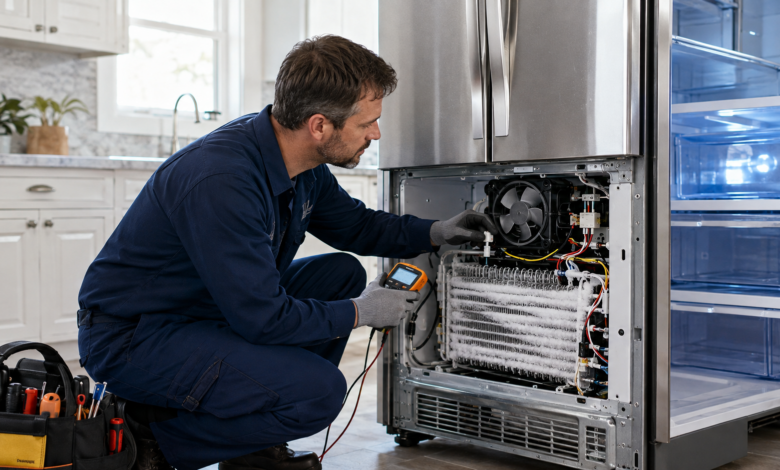
With the refrigerator unplugged, I removed the back panel inside the freezer compartment to access the evaporator coils and defrost components. Using a multimeter, I tested the defrost heater (continuity test) and the defrost thermostat. The defrost thermostat showed no continuity — it had failed open. The heater tested fine. I ordered a replacement thermostat for $18.
Step 5: Replace the Faulty Component and Verify
Replacing the defrost thermostat took about 20 minutes. After reassembling the freezer panel and plugging the refrigerator back in, I monitored it for a week. The Er-dH code did not return, and the refrigerator maintained consistent temperatures. Total cost: $18 for the part. A technician visit would have cost $150–$300 for diagnosis and repair. The key was testing before replacing — not guessing.
Frequently Asked Questions About Refrigerator Error Codes
What do refrigerator error codes mean?
Refrigerator error codes are alphanumeric fault codes displayed on the control panel to indicate a specific malfunction. They fall into categories including cooling errors, sensor errors, fan errors, defrost errors, and communication errors. The exact meaning varies by brand and model — always cross-reference the code with your owner’s manual or the manufacturer’s support documentation for accurate diagnosis.
How do I reset my refrigerator error code?
Unplug the refrigerator from the power outlet, wait 5–10 minutes, then plug it back in. This performs a hard reset and may clear temporary error codes caused by power fluctuations or brief sensor glitches. If the error code reappears within hours or days, the underlying fault has not been resolved and the relevant component needs to be tested and potentially replaced.
What is a refrigerator sensor error code?
A sensor error code indicates a problem with a thermistor — a temperature-sensing resistor that monitors compartment temperatures and feeds data to the control board. Common displays include Er-S, Er-1, Er-2, or similar. A faulty thermistor may cause continuous running, erratic cycling, or incorrect temperature readings. Thermistors can be tested with a multimeter and are generally inexpensive to replace.
What does a defrost error code mean on a refrigerator?
A defrost error code (Er-dH, Er-dF, Er-dE, or similar) indicates a failure in the automatic defrost system — specifically the defrost heater, defrost thermostat, or defrost timer/control board. A failed defrost system allows ice to accumulate on the evaporator coils, restricting airflow and causing poor cooling. Each component should be tested individually before replacement to avoid unnecessary parts costs.
When should I call a technician for a refrigerator error code?
Call a certified appliance technician if: the error code reappears after a reset and you are not comfortable testing components with a multimeter; the error involves the compressor or sealed refrigeration system (refrigerant); the refrigerator is under warranty (DIY repairs may void it); or the cost of parts approaches the cost of a new appliance. As a general guideline, if repair costs exceed 50% of the replacement value, replacement may be the more economical choice.
Refrigerator Repair Cost Comparison by Error Type
The table below provides estimated repair costs for common refrigerator error code causes in the United States. Costs are indicative and may vary by region, brand, and labor rates. DIY costs assume the part only; professional costs include a typical service call and labor.
| Error Type | Common Cause | DIY Part Cost (USD) | Professional Repair Cost (USD) |
|---|---|---|---|
| Defrost Error (Er-dH / Er-dF) | Defrost heater or thermostat | $10 – $40 | $150 – $300 |
| Sensor Error (Er-S / Er-1) | Thermistor replacement | $10 – $30 | $100 – $200 |
| Fan Error (Er-F / Er-FF) | Evaporator or condenser fan motor | $20 – $60 | $150 – $250 |
| Cooling Error (Er-C / Er-CO) | Condenser coil cleaning or fan | $0 – $60 | $100 – $350 |
| Control Board Error (Er-PC / Er-CB) | Main control board replacement | $80 – $200 | $200 – $500 |
| Compressor Issue | Compressor or sealed system | Not recommended DIY | $300 – $700+ |
Note: Costs are estimates based on typical U.S. market rates as of 2024–2025. Always obtain a written estimate before authorizing repairs. If repair costs exceed 50% of the refrigerator’s current market value, replacement may be more cost-effective.
Conclusion: Error Codes Are Clues, Not Verdicts
The most important thing I learned from my “Er-dH” experience is that a refrigerator error code is a starting point for diagnosis — not a final verdict. The code tells you which system has a problem; it does not tell you which specific component has failed. Testing each component methodically, rather than replacing parts by guesswork, is the difference between a $18 fix and a $300 service bill.
For most refrigerator error codes and fixes, the process is the same: identify the code category, consult your model’s service documentation, perform a power reset, and then test the relevant components in order of likelihood and accessibility. Defrost components, thermistors, and fan motors are generally accessible and affordable. Compressor and sealed system issues are the exception — these require a certified technician and a realistic cost-benefit assessment.
If your refrigerator is displaying an error code right now, start with the simplest step: unplug it for 10 minutes. If the code returns, look up your exact model number and code together. From there, you will have a much clearer picture of what you are dealing with — and whether it is a $20 part or a conversation with a technician.
Sources
- U.S. Department of Energy — Energy Saver: Refrigerator Maintenance Tips. Available at: energy.gov/energysaver/refrigerators
- Association of Home Appliance Manufacturers (AHAM) — Appliance Industry Data and Consumer Resources. Available at: www.aham.org
- International Society of Certified Electronics Technicians (ISCET) — Appliance Service Technician Certification Standards. Available at: www.iscet.org
- Roper R, et al. — «Failure mode analysis of domestic refrigeration appliances». International Journal of Refrigeration, 2018.
- Consumer Reports — Refrigerator Reliability and Repair Cost Survey, 2023. Available at: www.consumerreports.org