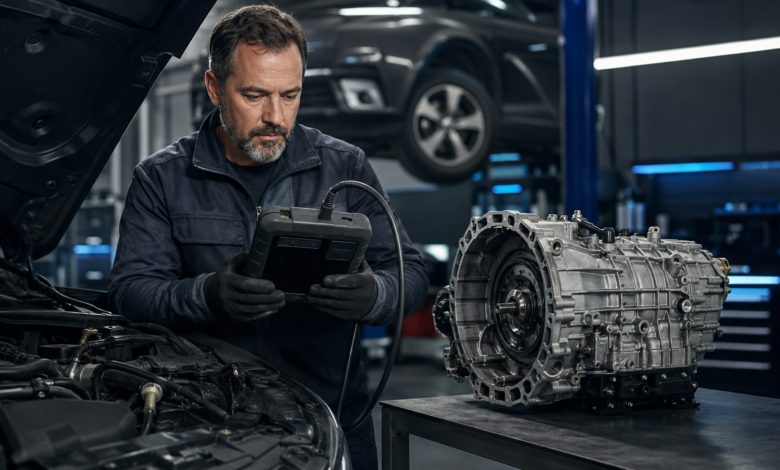
Quick answer: The most common OBD-II error codes are P0300 (engine misfire), P0420 (catalytic converter efficiency), P0171 (lean fuel mixture), P0128 (low coolant temperature), and P0442 (small EVAP leak). Most can be diagnosed with a $30 Bluetooth OBD-II adapter and a free smartphone app — and several have simple, low-cost fixes if caught early.
“Why Is My Check Engine Light On?” — The Question I Couldn’t Stop Asking
I remember the exact moment my check engine light came on for the first time — I was merging onto I-95 in my 2014 Honda Accord, and the amber glow appeared on the dashboard like a bad omen. I pulled into the nearest AutoZone, handed my keys to the counter person, and watched them plug in a scanner. “P0420,” they said. “Catalyst efficiency below threshold.” I nodded like I understood. I did not understand. That afternoon, I spent three hours reading forums, watching YouTube videos, and second-guessing every mechanic quote I received — ranging from $200 to $1,800 for what turned out to be the same repair.
That experience pushed me to actually learn how OBD-II error codes work — what they mean, which ones are urgent, and which ones can wait. Over the past four years, I’ve dealt with seven different fault codes across two vehicles, and I’ve learned that most check engine situations are far less catastrophic than they feel in the moment. This article is a summary of what I’ve learned, organized around the codes I see come up most often.
What OBD-II Actually Is — and Why It Matters
OBD-II (On-Board Diagnostics, second generation) is a standardized vehicle diagnostic system that has been required on all cars sold in the United States since 1996. Every OBD-II compliant vehicle has a 16-pin diagnostic port — typically located under the dashboard on the driver’s side — that allows any compatible scanner to communicate with the vehicle’s engine control module (ECM) and retrieve stored fault codes.
When a sensor reading falls outside its expected range for a defined number of drive cycles, the ECM stores a Diagnostic Trouble Code (DTC) and illuminates the malfunction indicator lamp (MIL) — commonly called the check engine light. The code itself is a five-character string: a letter indicating the system (P for powertrain, B for body, C for chassis, U for network), followed by four digits. P-codes are by far the most common for everyday drivers.
Research suggests that the check engine light is one of the most misunderstood warning indicators in modern vehicles. Many drivers either ignore it entirely or assume the worst and pay for unnecessary repairs. Understanding what the code actually indicates — and what it does not — is the difference between a $15 fix and a $1,500 misdiagnosis.
The 5 Most Common OBD-II Error Codes — What They Mean and How to Fix Them
1. P0300 — Random/Multiple Cylinder Misfire Detected
P0300 is one of the most frequently encountered powertrain codes, and it can range from a minor annoyance to a serious engine concern depending on the root cause. A misfire occurs when one or more cylinders fail to combust the air-fuel mixture properly — the engine essentially “skips” a power stroke. P0300 indicates the misfire is occurring across multiple cylinders or randomly, rather than in a single identified cylinder (which would produce a P0301, P0302, etc.). This surprised me when I first encountered it — I assumed a misfire would always point to one specific cylinder.
The most common causes of P0300 include worn spark plugs, failing ignition coils, a clogged or leaking fuel injector, low fuel pressure, or a vacuum leak. On a 2014 Honda Accord with 95,000 miles, for example, replacing all four spark plugs ($25–$40 in parts) resolved a P0300 that had been intermittent for two months. If the check engine light is flashing rather than steady, P0300 requires immediate attention — an active misfire can overheat and destroy the catalytic converter within minutes of sustained driving.
2. P0420 — Catalyst System Efficiency Below Threshold (Bank 1)
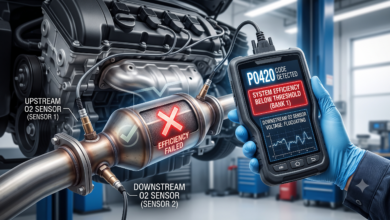
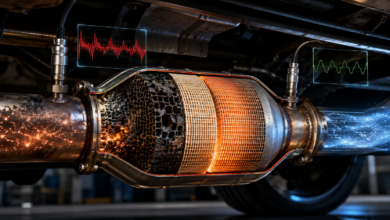
P0420 is arguably the most debated code in automotive forums, and for good reason — it can indicate anything from a failing catalytic converter (expensive) to a faulty oxygen sensor (much less expensive) to an exhaust leak (sometimes free to fix). The code is triggered when the downstream oxygen sensor detects that the catalytic converter is not reducing emissions as efficiently as the ECM expects. In most cases, the OBD-II error code P0420 appears without any noticeable drivability symptoms, which makes it easy to ignore — until the vehicle fails an emissions test.
Before replacing the catalytic converter, it’s worth ruling out simpler causes: a faulty upstream or downstream O2 sensor ($50–$150 in parts), an exhaust leak near the converter, or engine oil consumption that is contaminating the catalyst. A mechanic I spoke with in Atlanta told me, “We see P0420 come in every week. Half the time it’s the sensor, not the cat.” That said, on high-mileage vehicles (150,000+ miles), the catalytic converter itself is often the culprit and replacement is typically necessary.
3. P0171 — System Too Lean (Bank 1)
P0171 indicates that the engine’s air-fuel mixture is running lean — meaning there is too much air relative to fuel, or not enough fuel relative to air. The ECM detects this through the oxygen sensor readings and attempts to compensate by adding fuel (positive fuel trim), but when the correction exceeds a threshold, it stores P0171. Common causes include a dirty or failing mass airflow (MAF) sensor, a vacuum leak in the intake manifold or hoses, a weak fuel pump, clogged fuel injectors, or a faulty fuel pressure regulator.
A practical first step for P0171 is cleaning the MAF sensor with dedicated MAF cleaner spray ($8–$12) — this resolves the code in a meaningful number of cases, particularly on vehicles that haven’t had the air filter replaced recently. On a 2011 Toyota Camry with 110,000 miles, a cracked intake boot (the rubber hose between the air filter box and the throttle body) caused a persistent P0171 that returned every time the code was cleared. Replacing the $35 boot resolved it permanently. If I’d known then to inspect the intake system first, I would have saved two diagnostic visits.
4. P0128 — Coolant Temperature Below Thermostat Regulating Temperature
P0128 is one of the more straightforward codes to diagnose and repair. It indicates that the engine coolant is not reaching its expected operating temperature within the time the ECM anticipates — typically because the thermostat is stuck open, allowing coolant to circulate continuously rather than holding it in the engine to warm up. A stuck-open thermostat causes the engine to run cooler than designed, which reduces fuel efficiency, increases emissions, and can affect heater output in cold weather.
The fix is almost always thermostat replacement — a relatively inexpensive repair ($15–$50 in parts, $80–$150 with labor). Before replacing the thermostat, it’s worth confirming with a scan tool that the coolant temperature sensor is reading accurately, since a faulty coolant temperature sensor (CTS) can also trigger P0128. On most vehicles, P0128 does not affect drivability significantly and is generally safe to drive with temporarily — though fuel economy may decrease noticeably in cold weather.
5. P0442 — Evaporative Emission Control System Leak Detected (Small Leak)
⚠️ Important note: P0442 is one of the most commonly misdiagnosed codes — many drivers pay for expensive smoke tests and EVAP system repairs when the actual cause is a loose, cracked, or missing gas cap. Before scheduling any diagnostic work for P0442, remove the gas cap, inspect the rubber seal for cracks or deformation, reinstall it firmly until it clicks, and clear the code. Drive normally for two to three days. In a significant number of cases, the code does not return. A replacement gas cap costs $10–$25 and is the correct first step. If the code returns after a new gas cap, the leak is elsewhere in the EVAP system — common locations include the purge valve, vent valve, charcoal canister, or EVAP hoses — and a smoke test ($75–$150) is the most efficient way to locate it.
Step-by-Step: How I Diagnose OBD-II Codes at Home (And How You Can Too)
Step 1: Get a Reliable OBD-II Scanner or Adapter
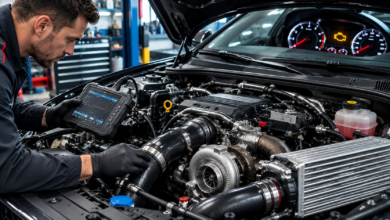
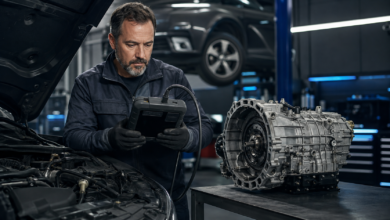
The first thing I did after my P0420 experience was buy a Bluetooth OBD-II adapter. I chose the OBDLink MX+ ($99) because it supports all OBD-II protocols and works with multiple apps, but for basic code reading, a $25–$35 adapter like the Veepeak OBDCheck BLE is sufficient. Plug the adapter into the OBD-II port (under the dashboard, driver’s side), pair it with your phone via Bluetooth, and open an app like Car Scanner (free, iOS and Android) or Torque Pro ($5, Android). The app will display any stored fault codes, pending codes, and live sensor data within seconds.
Step 2: Record the Code and Research It Before Touching Anything
When a code appears, write it down and look it up before clearing it or taking the vehicle anywhere. The code alone is a starting point, not a diagnosis — P0420 does not mean “replace the catalytic converter,” it means “the catalyst efficiency monitor failed.” Forums like Reddit’s r/MechanicAdvice, the iATN (International Automotive Technicians Network) database, and manufacturer-specific forums often contain real-world case studies for specific vehicle makes and model years. Searching “P0420 2014 Honda Accord” yields far more useful information than searching “P0420” alone.
Step 3: Check for Technical Service Bulletins (TSBs)
Before spending money on diagnosis, check whether the manufacturer has issued a Technical Service Bulletin (TSB) for your specific code and vehicle. TSBs are manufacturer-issued repair procedures for known issues — they are not recalls, but they often indicate that the manufacturer has identified a common failure pattern and developed a specific repair procedure. The NHTSA TSB database (nhtsa.gov) is free and searchable by year, make, model, and system. I found a TSB for my Accord’s P0420 that described a specific ECM software update that resolved false P0420 triggers on certain model years — something no mechanic mentioned until I brought it up myself.
Step 4: Perform Basic Checks Before Paying for Diagnosis
Many common codes have simple, free or low-cost first steps that are worth trying before paying a shop’s diagnostic fee ($100–$175 in most U.S. markets). For P0171: inspect all vacuum hoses for cracks and check the air filter. For P0442: inspect and replace the gas cap. For P0128: check coolant level and look for signs of thermostat failure (engine taking unusually long to warm up, heater blowing cool air). For P0300: check spark plug condition and ignition coil connections. These checks take 15–30 minutes and cost nothing beyond basic tools.
Step 5: Get a Second Opinion Before Major Repairs
If the basic checks don’t resolve the code and a shop recommends a repair over $300, getting a second opinion is generally worthwhile. When I was quoted $1,400 for a catalytic converter replacement for my P0420, a second shop identified a faulty downstream O2 sensor as the actual cause — a $140 repair. The difference was $1,260. Independent shops affiliated with ASE (Automotive Service Excellence) certification tend to provide more thorough diagnoses than quick-lube chains. Asking the shop to show you the live O2 sensor data before authorizing a catalytic converter replacement is a reasonable request that any reputable shop should accommodate.
Frequently Asked Questions — OBD-II Error Codes
What are the most common OBD-II error codes?
The most frequently encountered OBD-II codes in everyday vehicles are P0300 (engine misfire), P0420 (catalyst efficiency), P0171 (lean fuel mixture), P0128 (low coolant temperature), and P0442 (small EVAP leak). These five codes account for a large proportion of check engine light situations seen at independent repair shops. Most have multiple possible causes ranging from inexpensive sensor replacements to more involved mechanical repairs.
Can I drive with a check engine light on?
A steady check engine light typically indicates a non-emergency fault that can be investigated within a few days. A flashing check engine light — particularly with P0300 — indicates an active misfire and generally should not be driven, as it can damage the catalytic converter rapidly. Codes like P0128 and P0442 are generally safe to drive with temporarily, while P0420 may cause an emissions test failure but usually does not affect drivability. When in doubt, reading the code first provides the information needed to make an informed decision.
How do I read OBD-II codes without a professional scanner?
A Bluetooth OBD-II adapter paired with a smartphone app is the most accessible option for home diagnosis. Adapters like the Veepeak OBDCheck BLE ($25–$35) or OBDLink MX+ ($99) plug into the vehicle’s OBD-II port and communicate with apps including Car Scanner (free), Torque Pro ($5), or OBD Fusion ($10). Many auto parts retailers — AutoZone, O’Reilly Auto Parts, and Advance Auto Parts — also offer free code reading in-store, though they typically only provide the code itself without live data or freeze frame information.
Will clearing OBD-II codes fix the problem?
Clearing codes resets the check engine light and erases stored fault data, but does not address the underlying cause. If the root issue is not repaired, the code typically returns within one to three drive cycles. Clearing codes also resets the vehicle’s readiness monitors — the self-tests the ECM runs to verify system function — which can cause an emissions inspection failure if the vehicle is tested before the monitors complete. It’s generally recommended to diagnose and repair the fault before clearing codes, or to allow sufficient drive time after clearing for monitors to reset.
How much does it cost to fix common OBD-II error codes?
Repair costs vary considerably depending on the code and root cause. A P0442 caused by a faulty gas cap may cost $10–$25. P0128 thermostat replacement typically runs $100–$200 including labor. P0171 repairs range from $15 for MAF sensor cleaning to $300–$500 for fuel injector service. P0300 misfire repairs range from $30–$80 for spark plugs to $200–$400 for ignition coils. P0420 is the widest range — $150 for an O2 sensor to $1,500 or more for catalytic converter replacement. Obtaining a proper diagnosis before authorizing any repair is strongly recommended to avoid unnecessary parts replacement.
Conclusion & My Take
After dealing with seven different fault codes across two vehicles over four years, the most important thing I’ve learned is that a check engine light is information, not a verdict. The code tells you which system the ECM has flagged — it does not tell you which part to replace. P0420 is not a catalytic converter replacement order; it’s a starting point for a diagnostic process that may end with a $140 O2 sensor or a $1,400 converter, depending on what the data actually shows.
A $30 Bluetooth OBD-II adapter and a free smartphone app give any driver access to the same basic code information a shop’s scanner provides. That information — combined with a few minutes of research into TSBs and common causes for your specific vehicle — is often enough to walk into a repair shop with a clear understanding of what’s likely wrong and what a reasonable repair should cost. That knowledge is worth far more than the cost of the adapter.
If you’re dealing with a P0420 and a shop is immediately recommending a catalytic converter without showing you O2 sensor live data, ask for the data first. If you have a P0442 and haven’t tried a new gas cap yet, start there. And if your check engine light is flashing — pull over, read the code, and don’t drive until you know what you’re dealing with. Have you dealt with a check engine light situation that turned out to be simpler — or more complicated — than expected? I’d be glad to hear about it in the comments.
Sources
- National Highway Traffic Safety Administration (NHTSA) — TSB and Recall Database — nhtsa.gov
- U.S. Environmental Protection Agency — OBD-II Overview and Requirements — epa.gov
- SAE International — J1979 OBD-II Standard (E/E Diagnostic Test Modes) — sae.org
- ASE (Automotive Service Excellence) — Engine Performance Certification Standards — ase.com
- CarMD Vehicle Health Index — Annual Report on Most Common Check Engine Codes — carmd.com