Quick answer: Furnace error codes are communicated through LED blink sequences on the control board — count the blinks and match them to the label inside the furnace door. The most common errors are flame sensor faults (clean with emery cloth — 10-minute DIY fix), airflow errors (replace the filter), ignition lockouts (power reset after addressing the root cause), and overheating shutdowns (restricted airflow or failed blower motor). Gas valve faults and heat exchanger cracks require a certified HVAC technician.
The Furnace That Locked Out on the First Cold Night of the Season
The thermostat called for heat at 6 AM on the first genuinely cold morning of October. The furnace started — I heard the inducer motor spin up, the igniter glow, the gas ignite — and then it shut off. It tried again. Shut off again. After the third attempt, the LED on the control board started blinking: 3 long, 3 short. Code 33. I opened the furnace door, found the label, and read: “Limit device lockout — check filter and airflow.” The filter was so clogged it had collapsed inward. A $12 replacement filter and a power reset, and the furnace ran without issue for the rest of the winter.
That experience taught me two things about furnace error codes: first, that the error code label inside the furnace door is the most useful diagnostic tool in the house; and second, that the majority of furnace errors are caused by neglected maintenance — dirty filters, dirty flame sensors, blocked flues — rather than component failures. This guide covers the four main furnace error code categories, how to read blink codes, and which errors you can fix yourself versus which require a professional.
How to Read Furnace Error Codes: The LED Blink System
Unlike most appliances that display error codes on a digital screen, most residential furnaces communicate fault codes through an LED light on the control board. The LED blinks in a specific pattern — a sequence of long blinks followed by a sequence of short blinks — that together form the error code. For example, 3 long blinks followed by 3 short blinks indicates code 33; 1 long blink followed by 4 short blinks indicates code 14.
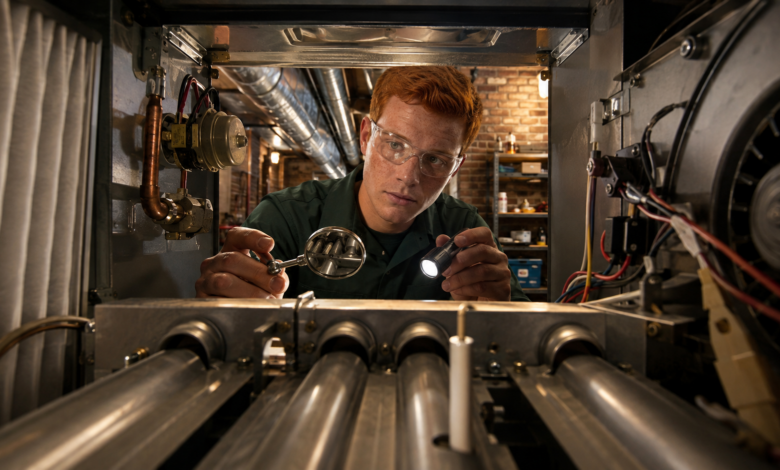
To read the blink code: open the furnace’s lower access panel (the door covering the burner compartment), locate the LED on the control board, and count the blinks in one complete sequence. The pause between the long-blink group and the short-blink group is typically 1–2 seconds; the pause between complete sequences is typically 3–5 seconds. Once you have the code, look it up on the error code label — a sticker printed with the complete code legend that is affixed to the inside of the furnace door panel on virtually every residential furnace manufactured in the last 30 years.
Some newer furnaces (particularly high-efficiency condensing furnaces from Carrier, Trane, Lennox, and Rheem) have a small digital display on the control board that shows the code directly. The interpretation is the same — look up the code on the door label or in the service manual.
The 5 Furnace Error Code Categories
1. Ignition Errors — Igniter Failure or No Flame Established
Ignition errors indicate that the furnace attempted to light the burner but failed to establish a flame within the allowed time. Common codes: 13, 14 (Carrier/Bryant), E1, E2 (generic), 31 (Lennox). The ignition sequence on a modern gas furnace is: inducer motor starts → pressure switch confirms draft → igniter heats up (hot surface igniter glows orange, typically 15–30 seconds) → gas valve opens → flame sensor confirms flame. A failure at any step triggers an ignition error.
The most common ignition failure causes are: a failed hot surface igniter (the igniter does not glow — visible through the sight glass on the burner compartment door), a dirty or failed flame sensor (the igniter glows, the burner lights briefly, then shuts off — the sensor cannot confirm the flame), and a gas supply issue (the igniter glows but no flame appears — check that the gas shutoff valve on the supply line to the furnace is fully open). After 3–5 failed ignition attempts, the control board enters lockout mode and requires a power reset to restart.
2. Flame Sensor Errors — Dirty or Failed Flame Sensor
Flame sensor errors are the single most common furnace fault. The flame sensor is a metal rod (typically stainless steel, 2–4 inches long) mounted in the burner flame path. It detects the presence of a flame by measuring a small electrical current (microamps) that flows through the flame between the sensor rod and the burner ground. A thin layer of oxidation on the sensor rod insulates it from the flame, reducing the current below the control board’s detection threshold and triggering a “no flame” shutdown. Common codes: 31, 33 (Carrier/Bryant), E3 (generic).
Cleaning the flame sensor is the most impactful DIY furnace maintenance task. Turn off power to the furnace at the disconnect switch or circuit breaker. Remove the single screw holding the flame sensor in place and slide it out of the burner compartment. Lightly rub the metal rod with fine steel wool (0000 grade) or fine emery cloth — do not use sandpaper, which removes too much material. Wipe clean with a dry cloth and reinstall. The entire process takes 10 minutes. If the furnace still shuts out after cleaning, the sensor has failed and must be replaced — replacement sensors cost $10–$25 and are available by furnace brand and model number.
3. Airflow and Pressure Errors — Dirty Filter, Blocked Flue, or Inducer Failure
Airflow and pressure errors indicate that the furnace cannot establish or maintain the required airflow through the combustion and heat exchange system. Common codes: 11, 12, 22, 24 (pressure switch errors), 33 (limit device — often airflow-related). The pressure switch is a safety device that confirms the inducer motor is creating sufficient draft through the heat exchanger and flue before allowing the gas valve to open.
The most common causes of pressure switch errors are: a clogged condensate drain line (on high-efficiency condensing furnaces — water backs up into the pressure switch hose and holds the switch open), a cracked or disconnected pressure switch hose, a blocked flue or intake pipe (bird nests, ice, debris), and a failed inducer motor (the motor that creates draft through the heat exchanger). Check the condensate drain and pressure switch hose before assuming inducer motor failure — these are DIY-accessible checks. A failed inducer motor requires professional replacement ($150–$400 for the part).
4. Overheating Errors — High-Limit Switch Tripped
Overheating errors indicate that the furnace’s high-limit switch — a temperature-activated safety device mounted on the heat exchanger — has tripped because the heat exchanger temperature exceeded the safe operating limit (typically 200°F–250°F). Common codes: 13, 33 (limit device lockout). The high-limit switch trips when airflow across the heat exchanger is insufficient to carry away the heat the burner is producing.
The most common causes of high-limit trips are: a severely clogged air filter (the single most common cause — replace the filter first), closed or blocked supply or return vents (check that all vents in the house are open and unobstructed), and a failed blower motor (the motor that circulates air through the heat exchanger and ductwork). A high-limit switch that trips repeatedly after filter replacement and vent inspection indicates a failed blower motor or a cracked heat exchanger — both require professional diagnosis. A cracked heat exchanger is a serious safety issue: combustion gases including carbon monoxide can enter the living space.
5. Control Board and Communication Errors — Board Failure or Sensor Fault
Control board errors indicate a fault in the furnace’s main control board — the circuit board that manages the ignition sequence, monitors all safety switches, and controls the blower motor. Common codes: 41, 42 (Carrier/Bryant — control board fault), E5, E6 (generic). Control board errors may also indicate a failed rollout switch (a safety device that trips if flames roll out of the burner compartment — indicating a blocked heat exchanger or cracked heat exchanger) or a failed inducer pressure switch.
⚠️ Important safety note: A tripped rollout switch is a serious safety indicator — it means flames are exiting the burner compartment in an uncontrolled direction, which can ignite surrounding materials. Do not reset a tripped rollout switch and restart the furnace without identifying and correcting the cause. A blocked heat exchanger or cracked heat exchanger requires professional inspection before the furnace is returned to service.
Furnace Error Code Troubleshooting: Step-by-Step
Step 1: Read the Blink Code and Check the Door Label
Open the furnace’s lower access panel and observe the LED on the control board. Count the long blinks, then the short blinks, to form the error code. Look up the code on the label affixed to the inside of the furnace door panel. The label lists every code the control board can generate and a brief description of each fault. Photograph the label with your phone — you will want to reference it during troubleshooting. If the furnace is in lockout (LED blinking a lockout code), perform a power reset: turn off the furnace disconnect switch or circuit breaker, wait 30 seconds, and restore power. The lockout clears, but the underlying fault must be addressed to prevent recurrence.
Step 2: Replace the Air Filter
A clogged air filter is the most common cause of furnace overheating errors, pressure switch errors, and blower-related faults. Locate the filter slot — typically in the return air duct adjacent to the furnace, or in a filter rack inside the furnace cabinet. Slide out the old filter and note the size printed on the frame (e.g., 16×25×1). Replace with a new filter of the same size and MERV rating. For most residential furnaces, a MERV 8–11 filter provides adequate filtration without excessive airflow restriction. Filters should be replaced every 1–3 months during the heating season. After replacing the filter, perform a power reset and observe whether the error recurs.
Step 3: Clean the Flame Sensor
For ignition errors and flame sensor errors (codes 31, 33, E3), clean the flame sensor. Turn off power at the furnace disconnect switch. Open the burner compartment door. Locate the flame sensor — a metal rod mounted on a ceramic insulator, positioned so the rod tip extends into the burner flame path. Remove the single mounting screw and disconnect the wire connector. Lightly rub the metal rod with 0000 steel wool or fine emery cloth until the rod is bright and clean. Wipe with a dry cloth, reconnect the wire, reinstall, and restore power. If the furnace runs through a complete heating cycle without shutting out, the cleaning resolved the issue.
Step 4: Check the Condensate Drain and Pressure Switch Hose
For pressure switch errors on high-efficiency condensing furnaces (codes 11, 12, 22, 24), check the condensate drain system. High-efficiency furnaces produce condensate (water) as a byproduct of combustion — this water drains through a PVC pipe to a floor drain or condensate pump. A clogged condensate drain causes water to back up into the pressure switch hose, holding the pressure switch in the open position and preventing ignition. Locate the condensate drain outlet and check for blockage. Also inspect the rubber hose connecting the pressure switch to the inducer housing — a cracked or disconnected hose causes the same pressure switch error as a failed inducer motor.
Step 5: Call a Technician for Gas Valve, Heat Exchanger, and Inducer Errors
Contact a certified HVAC technician if: the igniter glows but no flame appears (possible gas valve failure or gas supply issue); the high-limit switch trips repeatedly after filter replacement (possible cracked heat exchanger or failed blower motor); a rollout switch has tripped; the inducer motor is making unusual noises (grinding, squealing) or not starting; or the error persists after cleaning the flame sensor and replacing the filter. For any suspected gas leak (smell of gas near the furnace), turn off the gas supply at the main shutoff, evacuate the building, and call the gas utility company and 911 — do not attempt to diagnose a gas leak yourself.
Frequently Asked Questions About Furnace Error Codes
What are the most common furnace error codes?
The most common furnace error codes are flame sensor errors (code 31 or 33 on Carrier/Bryant — dirty sensor causing repeated ignition shutout), high-limit switch errors (code 33 — overheating due to dirty filter or failed blower), pressure switch errors (codes 11, 12, 22, 24 — blocked flue, clogged condensate drain, or failed inducer), and ignition lockout (codes 13, 14 — after multiple failed ignition attempts). Codes vary by brand — always check the label inside your furnace door for your specific model’s code legend.
How do I read furnace error codes?
Open the furnace’s lower access panel and observe the LED on the control board. Count the long blinks (first number) and the short blinks (second number) in one complete sequence — together they form the error code. For example, 3 long + 3 short = code 33. Look up the code on the label inside the furnace door. Some newer furnaces display the code directly on a small digital screen on the control board.
What does a flame sensor error mean on a furnace?
A flame sensor error means the sensor rod cannot confirm the burner is lit — most commonly because a thin layer of oxidation on the rod is preventing current flow through the flame. Clean the sensor rod with 0000 steel wool (10-minute DIY repair). If cleaning does not resolve the error, the sensor has failed and must be replaced ($10–$25). A flame sensor error causes the furnace to light briefly and then shut off, repeating until the control board enters lockout mode.
Why does my furnace keep shutting off and showing an error code?
The most common causes of a furnace repeatedly shutting off are: a dirty flame sensor (furnace lights then shuts off within seconds — clean the sensor), a clogged air filter causing high-limit trips (furnace runs briefly then shuts off on overheating — replace the filter), and ignition lockout after multiple failed ignition attempts (furnace will not start — power reset after addressing the root cause). If the furnace shuts off repeatedly after these checks, contact a technician.
When should I call a technician for a furnace error code?
Call a certified HVAC technician if: the igniter glows but no flame appears (gas valve or gas supply issue); the high-limit switch trips repeatedly after filter replacement (cracked heat exchanger or failed blower motor); a rollout switch has tripped; the error persists after cleaning the flame sensor and replacing the filter; or you smell gas near the furnace (evacuate and call 911 immediately). A cracked heat exchanger is a carbon monoxide hazard — never operate a furnace with a suspected cracked heat exchanger.
Furnace Repair Cost by Error Code Type
The table below provides estimated repair cost ranges for the most common furnace error code causes in the United States. DIY costs reflect the part only; professional costs include a typical service call and labor.
| Error Code / Fault | Common Cause | DIY Part Cost (USD) | Professional Repair Cost (USD) |
|---|---|---|---|
| Flame sensor error (31, 33, E3) | Dirty or failed flame sensor | $0 (cleaning) – $25 (replacement) | $80 – $200 |
| Ignition lockout (13, 14, E1) | Failed hot surface igniter | $20 – $50 | $100 – $250 |
| High-limit error (13, 33) | Dirty filter or failed blower motor | $5 – $20 (filter) | $150 – $500 (blower motor) |
| Pressure switch error (11, 12, 22, 24) | Clogged condensate drain or failed inducer | $0 (drain cleaning) | $150 – $450 (inducer motor) |
| Gas valve fault | Failed gas valve | Not recommended DIY | $200 – $600 |
| Control board error (41, 42, E5) | Failed control board | $80 – $300 (board) | $200 – $600 |
| Rollout switch trip | Blocked or cracked heat exchanger | Not applicable | $300 – $1,500+ |
| Cracked heat exchanger | Age, overheating, or manufacturing defect | Not applicable | $500 – $2,000+ (or replacement) |
Note: Costs are estimates based on typical U.S. market rates as of 2024–2025. A cracked heat exchanger repair cost often approaches or exceeds the cost of a new furnace — for units older than 15 years, full furnace replacement is frequently more cost-effective. Always obtain a written estimate before authorizing repairs. Gas valve replacement should be performed by a licensed HVAC technician — improper installation creates a gas leak hazard.
Conclusion: Most Furnace Errors Are Maintenance Failures, Not Component Failures
The code 33 lockout that stopped my furnace on the first cold morning of October was caused by a $12 air filter that had not been replaced in over a year. The repair cost $12 and took 5 minutes. That outcome — a maintenance failure masquerading as a component failure — is the most common furnace error code scenario. A dirty flame sensor, a clogged filter, a blocked condensate drain: these are the causes behind the majority of furnace error codes that homeowners encounter.
Furnace error codes are the control board’s way of telling you exactly what safety system tripped and why. The LED blink code and the door label give you the fault category in 60 seconds. From there, the diagnostic sequence is consistent: replace the filter, clean the flame sensor, check the condensate drain, and perform a power reset. These four steps resolve the majority of furnace errors at minimal cost.
The errors that require professional service — gas valve faults, cracked heat exchangers, failed inducer motors, and rollout switch trips — are clearly defined and involve either gas system components or safety-critical structural failures. A cracked heat exchanger is a carbon monoxide hazard and must never be operated. For everything else, the furnace door label, a replacement filter, and a clean flame sensor will resolve most of what you encounter.
Sources
- U.S. Consumer Product Safety Commission (CPSC) — Carbon Monoxide Safety and Home Heating Equipment. Available at: www.cpsc.gov
- U.S. Department of Energy (DOE) — Furnace and Boiler Efficiency Standards and Technology Overview. Available at: www.energy.gov
- North American Technician Excellence (NATE) — Gas Furnace Service Technician Certification Standards. Available at: www.natex.org
- Air-Conditioning, Heating, and Refrigeration Institute (AHRI) — Industry Standards for Residential Gas Furnaces. Available at: www.ahrinet.org
- Consumer Reports — Gas Furnace Reliability and Repair Cost Survey, 2023. Available at: www.consumerreports.org