P0420 Code: Causes, Symptoms and Fixes
Complete Guide to Catalyst System Efficiency Below Threshold (Bank 1)

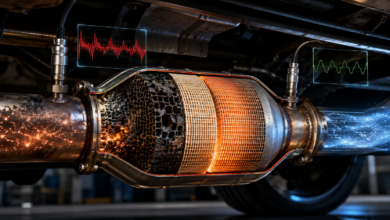
A catalytic converter is a critical exhaust emission control device. It converts harmful gases—such as carbon monoxide (CO), hydrocarbons (HC), and nitrogen oxides ($NO_x$)—into less harmful compounds like water vapor and carbon dioxide ($CO_2$).
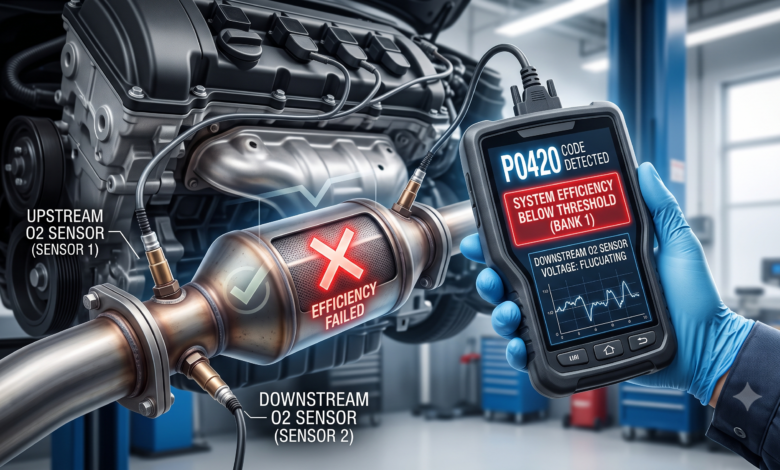
To monitor the health of the catalytic converter, your vehicle uses two oxygen ($O_2$) sensors:
-
Upstream $O_2$ Sensor (Sensor 1): Located before the catalytic converter; measures raw exhaust gas composition as it leaves the engine.
-
Downstream $O_2$ Sensor (Sensor 2): Located after the catalytic converter; monitors the gases exiting the converter.
When operating correctly, the upstream sensor’s voltage reading fluctuates rapidly, while the downstream sensor provides a relatively stable, steady voltage. If the catalytic converter fails or degrades, the downstream sensor begins mirroring the fluctuations of the upstream sensor. Once the efficiency drops below a set parameter (usually around 95% efficiency), the ECM (Engine Control Module) triggers the P0420 code.
Note on “Bank 1”: Bank 1 refers to the side of the engine that contains Cylinder #1. On inline engines (4-cylinder or inline-6), there is only one bank. On V-type engines (V6 or V8), Bank 1 is the side housing Cylinder #1.
Common Causes of Code P0420
While a failing catalytic converter is a primary suspect, replacing it immediately without further diagnosis is a common (and expensive) mistake. The P0420 causes can range from minor exhaust leaks to underlying engine misfires.
1. Exhaust System Leaks
An exhaust leak upstream or near the downstream oxygen sensor allows ambient air to enter the exhaust stream. This tricks the sensor into reading lean conditions, throwing off efficiency calculations.
2. Failing Oxygen ($O_2$) Sensors or Wiring
A faulty, contaminated, or aging downstream $O_2$ sensor (or damaged wiring harness) can send inaccurate voltage signals to the ECM, erroneously triggering the code.
3. Damaged or Clogged Catalytic Converter
Internal physical damage, melting of the internal ceramic honeycomb substrate due to raw fuel exposure, or thermal degradation will permanently reduce catalyst efficiency.
4. Engine Misfires or Rich/Lean Fuel Mixtures
If your engine is running too rich (excess fuel) or misfiring, unburned fuel enters the exhaust system. This causes extreme heat inside the catalytic converter, potentially melting the internal core over time.
5. Contamination (Coolant or Engine Oil Leaks)
A leaking head gasket (allowing coolant into combustion chambers) or worn piston rings/valve seals (allowing oil burn) can coat the catalyst surfaces, preventing catalytic reactions.
Symptoms of P0420
In many cases, a vehicle displaying a P0420 code will exhibit no noticeable driveability symptoms other than an illuminated dashboard light. However, depending on the root cause, you may observe:
-
Illuminated Check Engine Light (CEL): The primary and most consistent indicator.
-
Reduced Fuel Economy: Rich fuel mixtures or restricted exhaust flow can noticeably degrade miles-per-gallon (MPG).
-
Lack of Engine Power & Poor Acceleration: A severely clogged converter creates excessive exhaust backpressure, choking the engine.
-
Sulfur or “Rotten Egg” Smell: Unburned hydrocarbons passing through a struggling converter often produce a distinct hydrogen sulfide odor.
-
Rattling Noise Underneath the Car: Indicates that the ceramic honeycomb inside the catalytic converter has broken apart into loose pieces.
Step-by-Step Diagnostic Process
To avoid replacing expensive components unnecessarily, follow this logical diagnostic workflow:
[Scan OBD-II Codes] ➔ [Inspect Exhaust for Leaks] ➔ [Check Oxygen Sensor Data] ➔ [Inspect Catalyst/Engine Health]
-
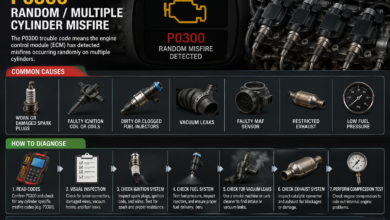
Scan for Additional OBD-II Codes: Always address codes related to misfires (P0300 series), $O_2$ sensors (P0130–P0167), or fuel trim issues (P0171/P0172) first. Fixing these may resolve the P0420 code automatically.
-
Visual Inspection: Check the exhaust pipes, welds, and gaskets between the manifold and catalytic converter for rust, cracks, or soot marks indicating a leak.
-
Inspect $O_2$ Sensor Wiring: Check for melted, frayed, or corroded wiring connected to the upstream and downstream sensors.
-
Analyze Live Data: Using an OBD-II scanner with live data features, monitor the voltage of the downstream $O_2$ sensor at operating temperature (around 2000 RPM). A steadily hovering voltage around 0.45V to 0.7V indicates a good catalyst; constant fluctuating voltages suggest a degraded converter or sensor fault.
-
Check Temperature Differential: Use an infrared thermometer to measure temperatures at the inlet and outlet pipes of the catalytic converter. A healthy converter’s outlet pipe should generally run higher in temperature than its inlet pipe by roughly 10°C to 20°C (50°F+).
How to Fix Code P0420
Finding the proper P0420 fix depends on your diagnostic findings:
Option 1: Repair Exhaust Leaks
If a leak is found before or near the catalytic converter, replace damaged exhaust gaskets, flex pipes, or clamp connections.
Option 2: Replace Oxygen Sensors
If diagnostic data shows a sluggish or failing downstream $O_2$ sensor, replace the faulty sensor with an OEM-spec equivalent.
Option 3: Fix Underlying Engine Issues
If misfire codes or rich/lean conditions are present, service the spark plugs, ignition coils, fuel injectors, or mass air flow (MAF) sensor to prevent damaging the new or existing catalyst.
Option 4: Replace the Catalytic Converter
If the catalytic converter is contaminated, physically broken, or thermally degraded, replacement is necessary. Always select a high-quality OEM or EPA/CARB-compliant aftermarket replacement to ensure long-term durability and emission compliance.
Can You Drive with a P0420 Code?
Technically, yes, you can drive short distances with a P0420 code if the vehicle drives normally and doesn’t exhibit severe power loss.
However, ignoring it for extended periods is risky. If the code is caused by an engine running rich or misfiring, continuing to drive will destroy a catalytic converter that might otherwise be salvageable. Additionally, a vehicle with an active P0420 code will automatically fail state or regional emissions testing.
Summary Checklist
| Component | Inspection Focus | Typical Resolution |
| Exhaust Pipes | Cracks, rust, pinhole leaks | Weld repairs or new gaskets |
| $O_2$ Sensors | Wiring integrity & live voltage graph | Sensor replacement |
| Engine Health | Misfires, oil consumption, coolant leaks | Spark plugs, coils, or engine repair |
| Converter Core | Outlet/Inlet temp delta & physical rattle | Catalytic converter replacement |